English
 Español
 tiếng việt
 русский
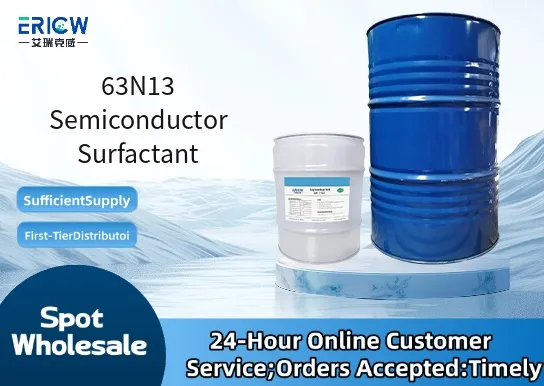
Ultra-low residue formulation designed to minimize metallic and ionic contamination in critical semiconductor cleaning processes.
Exceptional wetting and penetrating capability on hydrophobic silicon, SiO₂, and low-k dielectric surfaces.
Thermally stable up to 120 °C, supporting compatibility with high-temperature rinse and drying steps.
Non-foaming and rapidly rinsable under deionized water (DIW) and megasonic agitation.
Halogen-free and formulated without sulfonates or phosphates to meet stringent fab environmental controls.
Pre-deposition wafer cleaning for epitaxial growth and atomic layer deposition (ALD) readiness.
Post-CMP (Chemical Mechanical Planarization) residue removal for copper and barrier layers.
Photoresist strip aid in low-damage, non-oxidizing solvent-based systems.
Surface energy modification prior to thin-film coating or bonding processes.
Micro-contamination control in advanced packaging cleaning for fan-out wafer-level packaging (FOWLP).
| Chemical Type | Nonionic polyalkylene oxide derivative with tailored alkylphenol-free architecture |
| Product Form | Ambient-stable, clear, colorless to pale yellow liquid |
| Appearance | Homogeneous liquid, no phase separation at 5–40 °C |
| Primary Applications | Front-end-of-line (FEOL) and back-end-of-line (BEOL) aqueous and semi-aqueous precision cleaning |
| Key Features | Low surface tension (24.5 mN/m @ 25 °C), ultra-low TOC contribution (<0.5 ppm in 0.1% DIW solution) |
| Benefits | Reduces particle re-deposition; enables uniform meniscus retreat during spin-rinse-dry (SRD) |
| Regulatory Compliance | REACH SVHC compliant; RoHS 2015/863 Annex II compliant; no California Prop 65 listed substances |
| Storage Stability | ≥24 months unopened at 15–25 °C; stable after dilution for ≤72 hours in DIW |
| Common Compatible Systems | Suitability |
| Deionized Water (DIW) rinse modules | Highly Recommended – Optimized for inline spray and flood rinse at 0.01–0.05% v/v concentration |
| Isopropyl alcohol (IPA)-based drying enhancers | Recommended – Fully miscible; improves Marangoni drying efficiency without phase separation |
| Carbon dioxide (CO₂)-expanded liquid systems | Suitable – Demonstrated stability in subcritical CO₂-assisted cleaning formulations |
| Dilute citric acid or oxalic acid pre-rinse solutions | Recommended – No chelation-induced degradation; maintains surfactant integrity below pH 3.5 |
Q1: What is the CAS Registry Number for 63N13?
A: The CAS Number for 63N13 Semiconductor Surfactant is 2289471-83-5.
Q2: What is the recommended working concentration range?
A: Typical use concentration is 0.01–0.03% v/v in DI water for spray rinse; up to 0.05% v/v may be used for immersion applications with extended dwell time.
Q3: How does 63N13 differ from conventional alkylphenol ethoxylates (APEOs)?
A: 63N13 is APEO-free, non-bioaccumulative, and features a fully biodegradable polyether backbone — eliminating legacy toxicity and regulatory restrictions associated with APEOs while delivering superior substrate compatibility.
Q4: Is 63N13 subject to extractables or leachables concerns in high-purity process tools?
A: No. Extractables testing per SEMI F57-0318 shows <0.1 ppb total organic extractables in quartz and stainless-steel contact scenarios after 72-hour static exposure at 40 °C.
Q5: Does 63N13 require special handling or material compatibility verification?
A: Standard stainless-steel (316L) and fluoropolymer (PFA, ETFE) wetted materials are fully compatible; verification with elastomers (e.g., EPDM, Viton®) is recommended for continuous recirculation systems.
Contact With Us:
E-mail: wangxingqiang@ericwchem.com
Have a Questions? Call Us:
Add:
Building A1, Jiete Industrial Park, Huangpu District, Guangzhou City, Guangdong Province, China