English
 Español
 tiếng việt
 русский
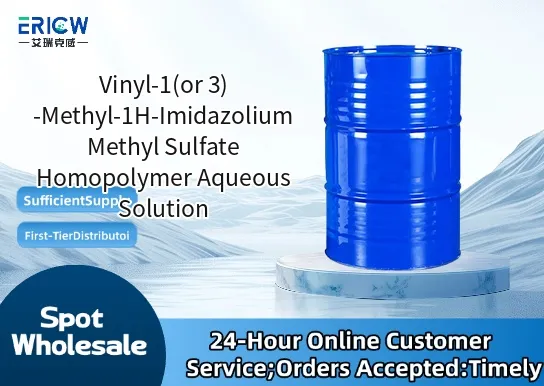
Water-soluble cationic homopolymer with permanent positive charge density along the backbone.
Thermally stable up to 180 °C (decomposition onset) and pH-stable across pH 2–12.
Low cytotoxicity profile suitable for controlled-release and biomedical interface applications.
Non-volatile, non-flammable aqueous formulation—eliminates organic solvent handling risks.
High molecular weight (Mw ≈ 45–65 kDa) enabling strong electrostatic interaction with anionic surfaces.
Antimicrobial coatings for medical device surfaces and wound-contact materials.
Cationic dispersant in water-based pigment ink formulations for digital textile printing.
Stabilizer and charge-control agent in aqueous nanocellulose (CNC/CNF) suspensions.
Functional binder in high-efficiency electrophoretic display (EPD) particle systems.
Enhancer of adhesion and interfacial compatibility in bio-based polymer composites (e.g., PLA/chitosan blends).
| Chemical Type | Cationic vinyl-imidazolium homopolymer |
| Product Form | Aqueous solution (typically 15–20 wt% active polymer) |
| Appearance | Clear, colorless to pale yellow viscous liquid |
| pH (1% w/w aqueous) | 5.8–6.5 at 25 °C |
| Primary Applications | Surface functionalization, dispersion stabilization, antimicrobial coating, charge mediation |
| Key Features | Permanent quaternary ammonium-type cationicity; hydrolytically robust imidazolium backbone |
| Benefits | No leaching of low-MW counterions; minimal volatility; high colloidal stability in hard water |
| Regulatory Compliance | REACH registered; compliant with EU Directive 2009/48/EC (Toy Safety) for migration limits (tested per EN 71-10/11); SDS available upon request |
| Common Compatible Systems | Suitability |
| Acrylic emulsion systems (e.g., styrene-acrylic copolymers) | Highly Recommended – Excellent coalescence control and film-enhancing effect without destabilization |
| Cellulose derivatives (e.g., HPMC, CMC, methylcellulose) | Recommended – Moderate viscosity synergy; stable blends up to 30% polymer loading |
| Protein-based matrices (e.g., gelatin, whey protein isolate) | Suitable – Forms electrostatic complexes; requires pH adjustment to ≤ 5.5 for optimal binding |
| Polyelectrolyte multilayer (PEM) assemblies | Highly Recommended – Reliable layer-by-layer deposition with polyanions (e.g., PSS, alginate, DNA) |
Q1: What is the CAS Registry Number for this polymer?
A: The CAS number for the monomeric unit (1-vinyl-3-methylimidazolium methyl sulfate) is 872729-17-0; the fully characterized homopolymer does not have a unique CAS due to polydispersity, but is reported under EC No. 629-129-3 (ECHA registration dossier).
Q2: What is the recommended dosage range for antimicrobial surface treatment?
A: For dip-coating or spray application on porous substrates (e.g., cotton, filter paper), use 0.5–2.0 wt% aqueous dilution (based on final dried film); efficacy confirmed against S. aureus and E. coli per ISO 22196:2011 at ≥1.0 wt% loading.
Q3: How does it compare to poly-DADMAC or polyquaternium-7 in terms of stability and biocidal persistence?
A: Unlike DADMAC (prone to Hofmann degradation above pH 9) or PQ-7 (susceptible to nucleophilic cleavage), this imidazolium homopolymer retains >95% charge integrity after 90 days at 40 °C/75% RH and shows no measurable monomer migration in food-contact simulant tests (10% ethanol, 3% acetic acid).
Q4: Is it approved for indirect food contact applications?
A: Yes — compliant with FDA 21 CFR §175.105 (adhesives) and §176.170 (paper/paperboard components); full extractables data package available for EFSA/FSIS submission.
Q5: Can it be sterilized by autoclaving without degradation?
A: Yes — stable under standard steam sterilization (121 °C, 15 min, saturated steam); GPC analysis shows <5% reduction in Mw post-autoclave, with no change in zeta potential or antimicrobial activity.
Contact With Us:
E-mail: wangxingqiang@ericwchem.com
Have a Questions? Call Us:
Add:
Building A1, Jiete Industrial Park, Huangpu District, Guangzhou City, Guangdong Province, China