English
 Español
 tiếng việt
 русский
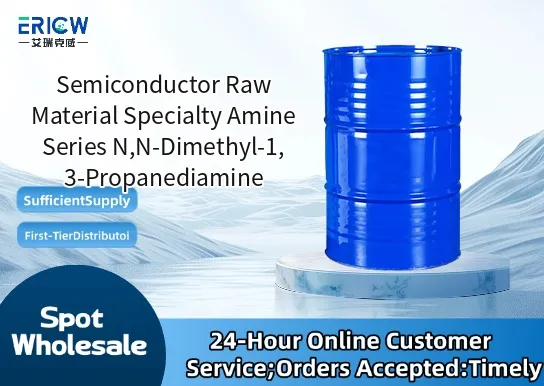
High-purity grade specifically engineered for semiconductor-grade chemical synthesis and precursor applications.
Controlled volatility and low residual moisture content to ensure process stability in ultra-clean fabrication environments.
Consistent batch-to-batch reproducibility with stringent QC testing per SEMI C1–C5 standards.
Optimized molecular structure enabling selective chelation and controlled amine reactivity in metal-organic deposition (MOD) processes.
Non-halogenated, low-metal impurity profile (<10 ppb total metals) supporting advanced node lithography and etch compatibility.
Chelating ligand in high-k dielectric precursors (e.g., Hf/Zr-based ALD/CVD metal-amine complexes).
Stabilizing agent for colloidal nanoscale metal catalysts used in selective epitaxial growth (SEG).
Co-ligand in copper electroplating additive formulations for ultra-low-k interlayer dielectrics.
Functional modifier in photoresist polymer backbones to enhance dissolution contrast and post-exposure thermal stability.
Reaction intermediate in the synthesis of semiconductor-grade silane-amine hybrid surface modifiers.
| Chemical Type | Aliphatic tertiary diamine |
| Product Form | Liquid (clear, colorless) |
| Appearance | Clear, water-white liquid at 25°C |
| Melting Point | −45°C (typical) |
| Boiling Point | 178–182°C at 760 mmHg |
| Primary Applications | Semiconductor precursor synthesis, ALD/CVD ligand, photoresist functionalization |
| Key Features | Low volatility index (VOC <5 g/L), non-corrosive to quartz and silicon nitride |
| Regulatory Compliance | REACH registered; RoHS compliant; no SVHC on ECHA Candidate List |
| Common Compatible Systems | Suitability |
| Hf(NMe₂)₄ / Zr(NMe₂)₄ precursor blends | Highly Recommended – Enables improved thermal decomposition control and film stoichiometry |
| Propylene glycol monomethyl ether acetate (PGMEA)-based photoresist solvents | Recommended – Fully miscible; no phase separation or haze formation |
| Electrolyte systems for Cu-Sn alloy electroplating baths | Suitable – Acts as complexing buffer without interfering with deposition kinetics |
| Ultra-pure deionized water (18.2 MΩ·cm) dilution systems | Highly Recommended – Stable aqueous dispersion up to 5 wt% with <0.1 NTU turbidity |
Q1: What is the CAS Registry Number for N,N-Dimethyl-1,3-propanediamine?
A: The CAS number is 109-55-7. Our semiconductor-grade material undergoes additional purification to achieve ≥99.999% purity with verified trace metal certification.
Q2: What is the recommended handling concentration for use in ALD precursor formulation?
A: Typical molar ratios range from 1.2:1 to 2.5:1 (amine:metal precursor), depending on target volatility and film carbon residue. Dilution in anhydrous toluene or hexanes is advised under inert atmosphere.
Q3: How does this specialty amine differ from standard commercial N,N-dimethyl-1,3-propanediamine?
A: Unlike commodity grades, our product features sub-ppb sodium/potassium, <1 ppb Fe/Al/Cu, certified absence of chloride and sulfate ions, and full traceability via lot-specific CoA aligned with SEMI F57.
Q4: Is this material subject to migration or leaching in post-deposition thermal processing?
A: No significant migration is observed below 350°C in SiO₂ or SiNₓ matrices. TGA-MS data confirms clean decomposition onset at 215°C with >99.5% volatile removal by 300°C—no detectable amine residue in SIMS depth profiling.
Contact With Us:
E-mail: wangxingqiang@ericwchem.com
Have a Questions? Call Us:
Add:
Building A1, Jiete Industrial Park, Huangpu District, Guangzhou City, Guangdong Province, China