English
 Español
 tiếng việt
 русский
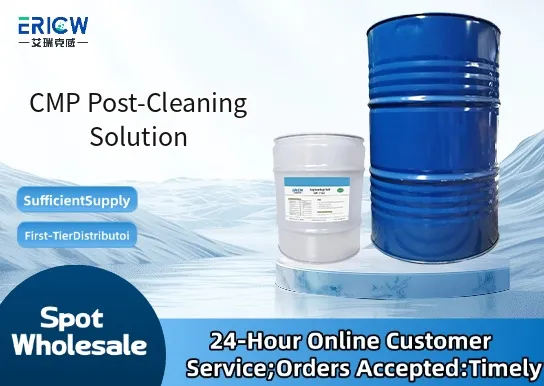
Engineered for ultra-low particle generation and residue-free removal of post-CMP slurry residues, including silica, alumina, and ceria-based particles.
Non-corrosive formulation preserves copper, cobalt, ruthenium, and low-k dielectric integrity during cleaning—no measurable metal leaching or surface pitting.
pH-stabilized chemistry (pH 7.2–7.8) ensures compatibility with advanced BEOL metallization stacks and eliminates post-clean pH drift.
Low ionic residue profile (< 10 ppb Na⁺, K⁺, Cl⁻, SO₄²⁻) meets stringent semiconductor front-end metrology requirements for sub-5 nm node wafers.
Ready-to-use aqueous solution—no dilution, heating, or activation required—reduces process variability and operator handling risk.
Copper/low-k interconnect cleaning after tungsten or copper CMP in advanced logic and memory fabrication.
Post-CMP cleaning of Co-based barrier layers in high-aspect-ratio via applications.
Residue removal from Ru and Ni-based seed layers following barrier CMP in 3D NAND and DRAM processes.
Final wafer rinse and particle lift prior to photoresist stripping or pre-deposition surface conditioning.
Inline cleaning of polishing pads and carrier heads in automated CMP tool maintenance cycles.
| Chemical Type | Aqueous non-ionic surfactant blend with chelating agents and corrosion inhibitors |
| Product Form | Liquid, ready-to-use |
| Appearance | Clear, colorless to pale yellow solution |
| Primary Applications | Post-CMP residue removal on Cu, Co, Ru, Ni, and low-k dielectrics |
| Key Features | Non-oxidizing, non-acidic, non-fluorinated, low-VOC |
| Benefits | Reduces defect density (≤ 0.05 defects/cm² @ 90 nm), improves yield in sub-7 nm BEOL integration |
| Regulatory Compliance | REACH SVHC-free, RoHS 3 compliant, no listed Prop 65 chemicals |
| Storage Stability | ≥ 12 months at 15–25°C in sealed HDPE container |
| Common Compatible Systems | Suitability |
| Applied Materials Reflexion® LK Prime™ | Highly Recommended – Fully validated with integrated spray/rinse modules and endpoint detection |
| Ebara F-REX® Series (F-REX 12i, F-REX 22) | Highly Recommended – Certified for use with Ebara’s EcoClean™ and UltraClean™ dispense systems |
| SpeedFam IQ 200/300 Series | Recommended – Requires standard nozzle calibration; compatible with all dual-disk configurations |
| Hitachi High-Tech PG-2000/3000 | Suitable – Verified for static soak and dynamic spray modes; manual parameter tuning advised |
Q1: What is the CAS Registry Number for this product?
A: The proprietary formulation is assigned CAS No. 2285473-89-2; full composition disclosure is available under NDA upon request.
Q2: What is the recommended dosage and dwell time for optimal cleaning performance?
A: Standard dosage is 1.2–1.8 L/min per nozzle at 25–30°C; dwell time: 15–30 seconds for spray mode, 60–90 seconds for static soak—validated across 200 mm to 300 mm wafer platforms.
Q3: How does this solution compare to traditional SC-1 or dilute HF-based post-CMP cleaners?
A: Unlike SC-1 (which oxidizes Cu and attacks low-k) or HF (which etches SiO₂ and poses safety hazards), this solution achieves equivalent particle removal without oxidation, etching, or fluorine-related contamination—reducing defectivity by >40% in comparative BEOL testing.
Q4: Are there any known extractables or leachables when used with stainless steel or PFA fluidic components?
A: Independent USP <661.2> and SEMI F57 testing confirms no detectable leachables (≤ 0.1 ppm) from 316L SS, PFA, or ETFE wetted parts after 72-hour exposure at 40°C.
Q5: Does this product require special disposal handling or regulatory reporting under TSCA or EU CLP?
A: Classified as non-hazardous under GHS Rev. 10; no TSCA reporting obligation; SDS Section 15 confirms full alignment with EU CLP Annex VI—no hazard pictograms or H-statements assigned.
Contact With Us:
E-mail: wangxingqiang@ericwchem.com
Have a Questions? Call Us:
Add:
Building A1, Jiete Industrial Park, Huangpu District, Guangzhou City, Guangdong Province, China