English
 Español
 tiếng việt
 русский
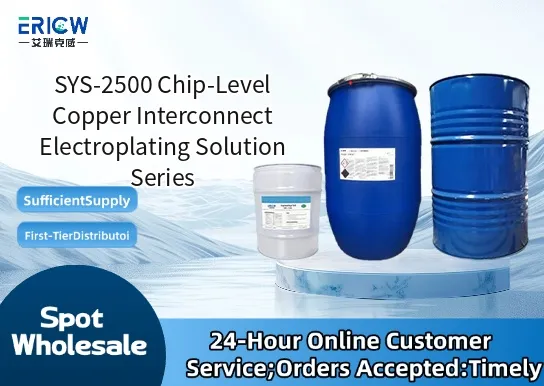
Ultra-low additive consumption enabling high bath stability and extended operational lifetime.
Exceptional throwing power for uniform copper deposition in sub-10 nm dual-damascene structures.
Low organic decomposition rate, minimizing particle generation and post-plating cleaning burden.
Compatible with advanced barrier/seed stacks including CoWP, Ru, and PVD/CVD Cu seed layers.
Engineered for seamless integration into high-throughput, automated electroplating tools with real-time monitoring support.
Front-end-of-line (FEOL) and back-end-of-line (BEOL) copper interconnect plating for logic and memory ICs.
Advanced packaging applications including 2.5D/3D TSV (Through-Silicon Via) filling.
High-performance computing (HPC) and AI accelerator chip interconnect metallization.
Sub-7 nm node FinFET and GAA (Gate-All-Around) transistor interconnect formation.
Wafer-level bumping and redistribution layer (RDL) copper plating.
| Chemical Type | Aqueous acidic copper sulfate-based electrolyte with proprietary suppressor, accelerator, and leveler additives |
| Product Form | Liquid concentrate (supplied as ready-to-dilute stock solutions) |
| Appearance | Clear to slightly opalescent blue liquid |
| pH Range (as prepared bath) | 0.8 – 1.2 (at 25 °C, 200 g/L Cu²⁺) |
| Copper Ion Concentration (typical working bath) | 180 – 220 g/L |
| Operating Temperature | 20 – 26 °C |
| Primary Applications | Chip-level copper electroplating for advanced semiconductor interconnects |
| Regulatory Compliance | REACH SVHC-free; RoHS 2015/863 compliant; no intentionally added PFAS |
| Common Compatible Systems | Suitability |
| Applied Materials SABRE® XP & EX platforms | Highly Recommended – Fully qualified with integrated metrology and closed-loop control |
| Lam Research Altus® Max platform | Highly Recommended – Optimized for multi-step fill and planarization integration |
| SCREEN Semiconductor Solutions FSP series | Recommended – Validated for high-uniformity wafer processing with inline DI rinse |
| Tokyo Electron (TEL) UEL line | Suitable – Requires minor anolyte flow calibration; stable performance across 300 mm wafers |
Q1: What is the CAS Registry Number for SYS-2500?
A: SYS-2500 is a proprietary multi-component formulation; individual components have distinct CAS numbers (e.g., copper sulfate pentahydrate: 7758-99-8), but the complete solution is assigned a unique product identifier (SYS-2500-PLT-01) per internal regulatory documentation.
Q2: What is the typical dosage range for SYS-2500 additives during operation?
A: Suppressor: 0.8–1.5 mL/L; Accelerator: 0.3–0.7 mL/L; Leveler: 0.1–0.4 mL/L — precise dosing determined via cyclic voltammetric stripping (CVS) and adjusted per tool-specific calibration curves.
Q3: How does SYS-2500 differ from legacy copper plating chemistries such as SYS-2000 or standard acid copper baths?
A: SYS-2500 features a next-generation suppressor architecture with enhanced adsorption kinetics on ultra-thin seed layers, reduced accelerator sensitivity to chloride drift, and improved compatibility with Co-based diffusion barriers — enabling robust fill at aspect ratios >12:1 without voids or seams.
Q4: Is SYS-2500 certified for use in ISO 9001 and IATF 16949 manufacturing environments?
A: Yes — all SYS-2500 production batches are manufactured under ISO 9001:2015-certified quality management systems, with full traceability, CoA (Certificate of Analysis), and lot-specific impurity profiling per SEMI C37 standards.
Q5: Does SYS-2500 exhibit measurable metal ion migration or leaching into low-k dielectrics during plating or post-anneal?
A: No detectable copper migration into SiCOH or porous organosilicate glass (OSG) dielectrics has been observed under qualified process conditions (≤400 °C anneal, ≤25 nm barrier thickness), as confirmed by TOF-SIMS depth profiling and electrical leakage testing.
Contact With Us:
E-mail: wangxingqiang@ericwchem.com
Have a Questions? Call Us:
Add:
Building A1, Jiete Industrial Park, Huangpu District, Guangzhou City, Guangdong Province, China