English
 Español
 tiếng việt
 русский
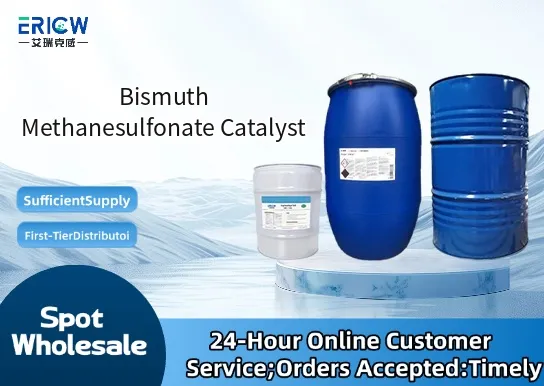
Low-toxicity bismuth-based alternative to traditional heavy-metal catalysts (e.g., lead, tin, mercury).
High catalytic activity in esterification, transesterification, and polycondensation reactions at mild temperatures.
Excellent hydrolytic stability and resistance to deactivation in moisture-containing reaction systems.
Non-volatile and thermally stable up to 220 °C, minimizing process volatility and emission concerns.
Readily soluble in polar organic solvents (e.g., methanol, THF, ethyl acetate) and compatible with common polymer matrices.
Biodiesel production via transesterification of vegetable oils and waste cooking oils.
Catalysis in synthesis of biodegradable polyesters (e.g., poly(butylene succinate), PBS).
Accelerating crosslinking reactions in low-VOC alkyd resins and waterborne coatings.
Facilitating ring-opening polymerization (ROP) of lactides and lactones for PLA and PCL precursors.
Enabling selective acylation and glycosylation in fine chemical and pharmaceutical intermediate synthesis.
| Chemical Type | Bismuth(III) methanesulfonate complex |
| Product Form | Free-flowing white to off-white crystalline powder |
| Appearance | Crystalline solid, hygroscopic under high humidity |
| Melting Point | 145–152 °C (decomposes above 160 °C) |
| Primary Applications | Esterification, transesterification, polyester synthesis, coating crosslinking |
| Key Features | Heavy-metal-free, non-corrosive, low odor, minimal color formation |
| Benefits | Reduced regulatory burden, improved worker safety profile, simplified waste handling |
| Regulatory Compliance | REACH registered; compliant with EU Directive 2009/48/EC (Toy Safety) for migration limits |
| Common Compatible Systems | Suitability |
| Vegetable oil methyl ester (FAME) transesterification | Highly Recommended – Delivers >98% conversion within 60 min at 65 °C |
| Alkyd resin crosslinking (with dimer acid or fatty acid modifiers) | Recommended – Enhances through-cure without yellowing or blistering |
| Poly(lactic acid) (PLA) melt polycondensation | Suitable – Effective at 130–150 °C; requires inert atmosphere for optimal Mw control |
| Waterborne acrylic/polyurethane hybrid dispersions | Recommended – Stable dispersion; no gelation observed at ≤0.3 wt% loading |
Q1: What is the CAS Registry Number for Bismuth Methanesulfonate Catalyst?
A: The CAS number is 13770-34-0 (Bismuth(III) methanesulfonate, commonly referenced as Bi(OMs)₃).
Q2: What is the typical recommended dosage range in esterification reactions?
A: Standard loading is 0.05–0.3 mol% relative to carboxylic acid group; optimal performance is typically observed at 0.1–0.2 mol% with minimal residual catalyst impact on product purity.
Q3: How does it compare to dibutyltin dilaurate (DBTDL) in polyurethane catalysis?
A: Unlike DBTDL, bismuth methanesulfonate exhibits negligible toxicity (non-reprotoxic per CLP), lower volatility, and superior selectivity for gelling over blowing reactions—however, it is not a direct replacement in fast-rise flexible PU foams requiring ultra-rapid kinetics.
Q4: Is it compliant with food-contact regulations (e.g., FDA 21 CFR, EU 10/2011)?
A: It is not currently authorized for direct food-contact applications under FDA or EU plastic regulation frameworks; however, it meets strict migration thresholds (<0.01 mg/kg) in indirect contact scenarios when fully reacted and purified—consult technical dossier for extractables data.
Contact With Us:
E-mail: wangxingqiang@ericwchem.com
Have a Questions? Call Us:
Add:
Building A1, Jiete Industrial Park, Huangpu District, Guangzhou City, Guangdong Province, China