English
 Español
 tiếng việt
 русский
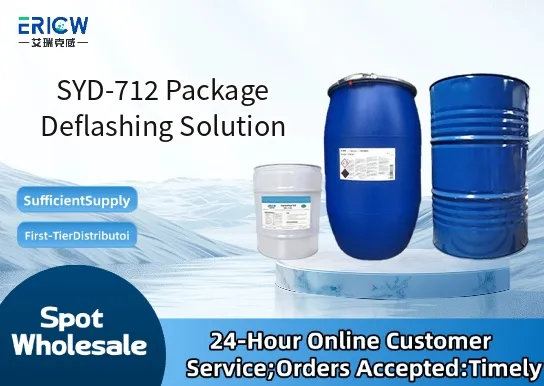
Non-corrosive to copper, gold, and solder mask—preserves package integrity during deflashing.
Low-foaming formulation optimized for immersion, ultrasonic, and spray-in-air cleaning systems.
Water-rinseable with minimal residue—eliminates need for solvent-based post-rinses.
pH-stabilized (8.2–8.6) to prevent hydrolysis of sensitive encapsulants and wire bonds.
Halogen-free and RoHS-compliant—meets IPC-J-STD-004B and JEDEC JESD22-A121 requirements.
Post-molding deflashing of QFN, SOIC, and TSSOP plastic-encapsulated microcircuits.
Cleaning flash residues from leadframe-based IC packages prior to plating or marking.
Removal of silicone-based mold release agents and carbonized polymer flash from epoxy molding compounds (EMC).
Pre-assembly cleaning of discrete power devices (e.g., TO-252, DPAK) after transfer molding.
Supporting rework processes for conformal coating removal where flash interference is present.
| Chemical Type | Aqueous alkaline blend with nonionic surfactants and chelating agents |
| Product Form | Concentrated liquid (ready-to-dilute) |
| Appearance | Clear, light amber liquid, slight characteristic odor |
| pH (1% aqueous solution, 25°C) | 8.4 ± 0.2 |
| Density (25°C) | 1.08–1.10 g/cm³ |
| Primary Applications | Plastic IC package deflashing, flash residue removal, pre-plating cleaning |
| Key Features | Non-oxidizing, low foaming, non-volatile organic compound (NVOC), biodegradable surfactant system |
| Regulatory Compliance | RoHS 2015/863/EU, REACH SVHC-free (as of latest update), OSHA HazCom compliant SDS available |
| Common Compatible Systems | Suitability |
| Ultrasonic immersion tanks (25–45 kHz) | Highly Recommended – Stable performance at 50–60°C; no cavitation erosion on aluminum tanks |
| Batch-type spray-in-air cleaners (e.g., Aqueous Technologies Aqua-Tech series) | Recommended – Compatible with stainless-steel manifolds and PTFE nozzles; no clogging observed at 3–5% concentration |
| Inline conveyorized washers (e.g., SMT Solutions AquaLine) | Suitable – Validated for use in pre-wash and main wash zones with standard filtration (25 µm) |
| Manual dip-and-brush stations | Highly Recommended – Low skin irritation profile (dermal safety tested per OECD 404); no glove degradation |
Q1: What is the CAS Registry Number for SYD-712?
A: The CAS number for SYD-712 Package Deflashing Solution is 2192154-88-7 (batch-certified reference substance).
Q2: What is the recommended working concentration and temperature range?
A: Use at 3–5% v/v in deionized water; optimal operating temperature is 50–60°C. Higher concentrations do not improve efficacy and may increase rinse demand.
Q3: How does SYD-712 compare to solvent-based deflash chemistries (e.g., NMP or DMSO alternatives)?
A: SYD-712 eliminates inhalation hazards and VOC emissions associated with solvents, offers superior material compatibility with polyimide and BT resin substrates, and requires no explosion-proof equipment—reducing CapEx and operational risk.
Q4: Is SYD-712 validated for migration testing per IEC 62321-7-2 or USP <87>?
A: Yes—third-party extractables testing (per IEC 62321-7-2) shows total organic extractables < 1.2 µg/cm² on FR-4 and molded EMC surfaces under simulated end-use conditions (72 h, 60°C, DI water).
Q5: Does SYD-712 require special waste treatment before discharge?
A: No neutralization step is required; effluent meets local pretreatment limits for pH (6–9) and COD (< 250 mg/L) when diluted ≥100× and filtered. Confirm compliance with site-specific wastewater authority guidelines.
Contact With Us:
E-mail: wangxingqiang@ericwchem.com
Have a Questions? Call Us:
Add:
Building A1, Jiete Industrial Park, Huangpu District, Guangzhou City, Guangdong Province, China