English
 Español
 tiếng việt
 русский
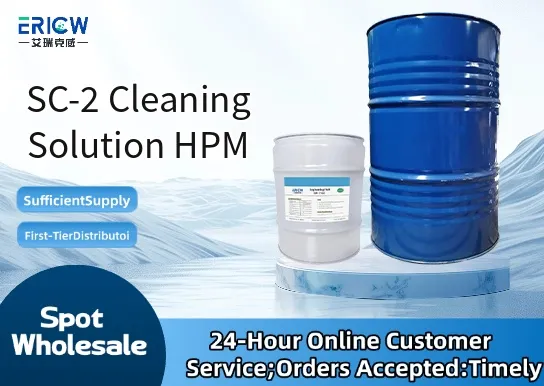
High-purity, low-metal-content formulation optimized for critical semiconductor wet processing.
Engineered for superior removal of organic residues, native oxides, and trace metallic contaminants without substrate attack.
Stable performance across extended bath life under controlled temperature and concentration conditions.
Compatible with automated dispensing systems and inline monitoring for process repeatability.
Low outgassing and minimal volatile organic compound (VOC) content for cleanroom-compatible handling.
Pre-gate oxide cleaning in advanced CMOS and FinFET fabrication.
Post-etch residue removal for metal and dielectric layers (e.g., TiN, TaN, SiO₂).
Wafer surface preparation prior to epitaxial growth or ALD/CVD deposition.
Cleaning of photomask blanks and reticles in lithography tool maintenance.
Recovery cleaning of reusable quartz and silicon process carriers.
| Chemical Type | Aqueous-based alkaline peroxide mixture (NH₄OH/H₂O₂/H₂O) |
| Product Form | Liquid concentrate (ready-to-dilute) |
| Appearance | Clear, colorless to pale yellow solution |
| pH (1:10 dilution, 25°C) | 10.2 – 10.8 |
| Primary Applications | SC-2 standard clean (RCA clean), particle/organic/metal removal |
| Key Features | Ultra-low Na⁺, K⁺, Fe, Cu, Ni, and Cl⁻ ion content (<10 ppt by ICP-MS) |
| Benefits | Minimizes recontamination risk; supports sub-5nm node yield requirements |
| Regulatory Compliance | REACH compliant; SDS available; not classified as hazardous under GHS (Category 0) |
| Common Compatible Systems | Suitability |
| SEZ® / SCREEN® Wet Bench Platforms | Highly Recommended – Fully validated for bath stability and particle control |
| Tokyo Electron (TEL) ACTRA™ Series | Recommended – Requires flow rate and temperature calibration per tool spec |
| Applied Materials Aera™ Single-Wafer Clean Tools | Highly Recommended – Optimized for high-precision spray and megasonic integration |
| Modular Inline DI Water + Chemical Delivery Systems | Suitable – Compatible with stainless steel 316L and PFA fluidic paths |
Q1: What is the CAS Registry Number for SC-2 Cleaning Solution HPM?
A: SC-2 Cleaning Solution HPM is a proprietary formulated mixture; individual components have CAS numbers (e.g., NH₃: 7664-41-7; H₂O₂: 7722-84-1), but the final product is assigned a unique batch-specific formulation ID—not a single CAS number—per regulatory guidance for multi-component industrial cleaners.
Q2: What is the recommended working concentration and temperature range?
A: Standard dilution is 1:1:5 (NH₃:H₂O₂:H₂O) using ultra-pure DI water (18.2 MΩ·cm). Optimal temperature range is 20–25°C; higher temperatures (>30°C) accelerate H₂O₂ decomposition and reduce bath life.
Q3: How does SC-2 Cleaning Solution HPM differ from conventional SC-2 solutions?
A: Unlike generic SC-2 blends, HPM-grade SC-2 undergoes additional sub-0.1 µm filtration, ultra-trace metal purification (≤5 ppt Fe, Cu), and rigorous lot-to-lot consistency testing—ensuring compatibility with advanced logic and memory device manufacturing.
Q4: Is SC-2 Cleaning Solution HPM certified for use in ISO Class 1 cleanrooms?
A: Yes—certified per ISO 14644-1 Class 1 for airborne molecular contamination (AMC) and validated for non-volatile residue (NVR) <0.05 ng/cm² after evaporation under cleanroom conditions.
Q5: Does SC-2 Cleaning Solution HPM exhibit leaching or extractables when in contact with fluoropolymer (e.g., PFA, FEP) piping?
A: No measurable leaching or extractables observed per USP <661.3> and SEMI F57 testing; validated for ≤24-hour static exposure and continuous recirculation at 25°C in certified PFA fluidic systems.
Contact With Us:
E-mail: wangxingqiang@ericwchem.com
Have a Questions? Call Us:
Add:
Building A1, Jiete Industrial Park, Huangpu District, Guangzhou City, Guangdong Province, China