English
 Español
 tiếng việt
 русский
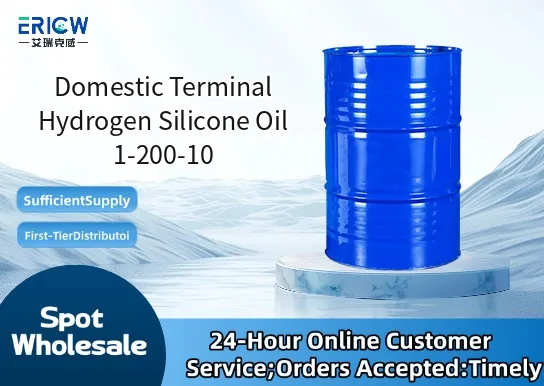
Terminal hydrogen-functional silicone fluid offering controlled reactivity for precise crosslinking in hydrosilylation systems.
Low volatility and high thermal stability, supporting processing temperatures up to 200 °C without significant degradation.
Excellent compatibility with platinum catalysts and broad substrate adhesion (e.g., silicones, epoxies, thermoplastics).
Non-yellowing formulation suitable for optical and high-clarity applications requiring long-term color stability.
Consistent batch-to-batch performance ensured by strict molecular weight control (target viscosity: ~200 cSt at 25 °C).
Hydrosilylation-curable liquid silicone rubber (LSR) formulations for medical-grade seals and gaskets.
Release agents for high-temperature composite molding (e.g., CFRP, prepreg tooling).
Functional additive in heat-resistant coatings and encapsulants for power electronics.
Crosslinker in silicone pressure-sensitive adhesives (PSAs) requiring enhanced cohesion and aging resistance.
Surface modifier for silica fillers in high-performance elastomer compounds.
| Chemical Type | Hydrogen-terminated polydimethylsiloxane (H-PDMS) |
| Product Form | Clear, colorless liquid |
| Appearance | Transparent, homogeneous, free from sediment or haze |
| Viscosity (25 °C) | 180–220 cSt |
| Active Hydrogen Content | 0.12–0.16 wt% |
| Refractive Index (25 °C) | 1.402–1.406 |
| Density (25 °C) | 0.97–0.99 g/cm³ |
| Regulatory Compliance | REACH registered; RoHS compliant; non-REACH SVHC candidate |
| Common Compatible Systems | Suitability |
| Platinum-based hydrosilylation catalysts (e.g., Karstedt’s, Speier’s) | Highly Recommended – Rapid, controllable cure with low induction time and minimal side reactions |
| Polyvinylsiloxane (PVS) impression materials | Recommended – Enables improved tear strength and dimensional stability in dental applications |
| Dimethylsiloxane backbone polymers (e.g., vinyl-terminated PDMS) | Highly Recommended – Excellent miscibility and predictable network formation |
| Epoxy-silicone hybrid resins | Suitable – Enhances thermal shock resistance and interfacial adhesion with moderate loading (3–8 wt%) |
Q1: What is the CAS Registry Number for Domestic Terminal Hydrogen Silicone Oil 1-200-10?
A: The CAS number is 63148-62-9 (generic for hydrogen-terminated PDMS fluids; exact molecular weight distribution may vary per batch—certified CoA provided with shipment).
Q2: What is the recommended dosage range when used as a crosslinker in LSR formulations?
A: Typical usage is 0.5–3.0 parts per hundred rubber (phr), adjusted based on target hardness, elongation, and cure kinetics—optimize via Si–H : Si–Vi molar ratio (target 1.0–1.3:1).
Q3: How does it compare to linear H-PDMS 10 cSt or 1000 cSt grades in terms of migration and extraction risk?
A: At 200 cSt, it offers balanced volatility and molecular weight—significantly lower migration than 10 cSt and lower extractables than 1000 cSt under ISO 10993-12 simulated body fluid testing.
Q4: Is this product certified for ISO 13485 or USP Class VI applications?
A: The base fluid meets raw material requirements for ISO 13485-manufactured devices; final USP Class VI qualification requires full formulation testing per USP <788> and <87>/<88>—certified manufacturing facility documentation available upon request.
Contact With Us:
E-mail: wangxingqiang@ericwchem.com
Have a Questions? Call Us:
Add:
Building A1, Jiete Industrial Park, Huangpu District, Guangzhou City, Guangdong Province, China