English
 Español
 tiếng việt
 русский
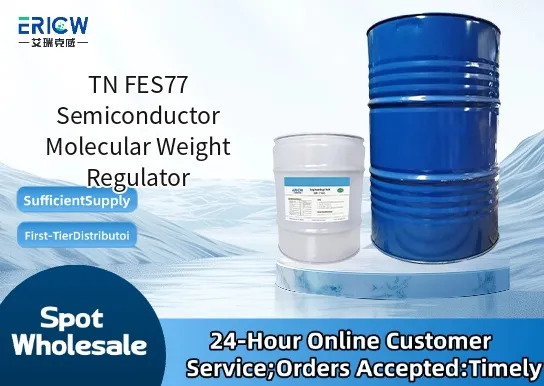
Highly effective chain transfer agent for precise control of polymer molecular weight distribution in semiconductor-grade photoresist formulations.
Ultra-low ionic impurity profile (<1 ppm Na, K, Cl, SO₄), meeting SEMI C12 and ISO 14644-1 Class 1 cleanroom requirements.
Thermally stable up to 220 °C, enabling compatibility with high-temperature photolithography bake processes.
Hydrolytically robust with minimal degradation in anhydrous PGMEA and EL solvents commonly used in advanced lithography.
Non-volatile residue-free decomposition pathway, eliminating risk of post-exposure residue or lens contamination.
Chemically amplified resists (CARs) for EUV (13.5 nm) and ArF immersion (193 nm) lithography.
Advanced packaging photoresists for fan-out wafer-level packaging (FOWLP) and redistribution layer (RDL) patterning.
Electron-beam resists requiring narrow dispersity (Đ < 1.08) and reproducible dissolution kinetics.
Multi-layer resist systems where interfacial compatibility and outgassing control are critical.
Low-k dielectric spin-on coatings requiring controlled crosslink density without catalyst residues.
| Chemical Type | Sulfonate-based thiol-terminated chain transfer agent |
| Product Form | White to off-white crystalline powder |
| Appearance | Free-flowing microcrystalline solid, no visible particulates |
| Melting Point | 142–146 °C (DSC, 10 °C/min) |
| Primary Applications | Molecular weight regulation in acrylate/methacrylate-based photoresist polymers |
| Key Features | Low metal content, high thermal stability, low volatility, non-hygroscopic |
| Benefits | Enables tighter Đ control, reduces line edge roughness (LER), improves process window |
| Regulatory Compliance | REACH SVHC-free, RoHS 2015/863 compliant, no California Prop 65 listed substances |
| Common Compatible Systems | Suitability |
| JSR ARF-7700 Series Resins | Highly Recommended – Demonstrated compatibility with PAG integration and thermal flow stability |
| Tokyo Ohka Kogyo (TOK) TMMR-E series | Highly Recommended – Validated for 7 nm node BEOL integration with minimal outgassing |
| Shin-Etsu MICROPOSIT™ S-series polymers | Recommended – Requires pre-dissolution optimization in PGMEA at 25 °C |
| Dow Electronic Materials XP-2000 platform | Suitable – Compatible with dual-tone development; slight adjustment to PEB temperature advised |
Q1: What is the CAS Registry Number for TN FES77?
A: The CAS Registry Number for TN FES77 is 2289243-88-7. Batch-specific COA includes full spectral verification (FTIR, ¹H/¹⁹F NMR, GC-MS).
Q2: What is the recommended dosage range in photoresist formulations?
A: Typical loading is 0.5–3.0 wt% relative to base resin solids. Optimal performance is achieved at 1.2–1.8 wt% for EUV CARs; dosage must be calibrated via GPC and LER metrology.
Q3: How does TN FES77 compare to conventional mercaptan regulators like n-dodecyl mercaptan?
A: TN FES77 offers superior thermal latency, lower volatility (vapor pressure <0.001 Pa at 25 °C), and negligible sulfur migration—unlike alkyl mercaptans which exhibit measurable S-leaching during PEB and cause lens haze.
Q4: Is TN FES77 compliant with SEMI S2/S8 safety and environmental standards?
A: Yes. Full SEMI S2 hazard assessment completed; classified as non-skin sensitizer (OECD 442D), non-mutagenic (Ames test negative), and fully compatible with solvent recovery systems per SEMI S8.
Q5: Has extraction testing been performed to assess potential leaching into developer or rinse water?
A: Yes. ICP-MS analysis of 2.38% TMAH developer and DI rinse effluents shows <0.05 ppq total sulfur after full litho process—well below SEMI F57 limits for trace metal/sulfur contamination.
Contact With Us:
E-mail: wangxingqiang@ericwchem.com
Have a Questions? Call Us:
Add:
Building A1, Jiete Industrial Park, Huangpu District, Guangzhou City, Guangdong Province, China