English
 Español
 tiếng việt
 русский
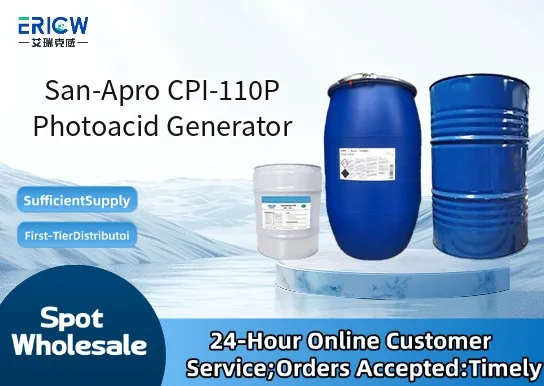
High quantum yield of acid generation under 365 nm (i-line) exposure, enabling efficient lithographic patterning.
Excellent thermal stability up to 180 °C, minimizing premature acid release during pre-bake and post-exposure bake steps.
Low volatility and negligible sublimation at standard processing temperatures, ensuring consistent film uniformity and shelf-life stability.
High solubility in common photoresist casting solvents including PGMEA, ethyl lactate, and propylene glycol monomethyl ether.
Controlled acid strength (H₀ ≈ –2.1) optimized for high-resolution chemically amplified resists without excessive deprotection diffusion.
i-line (365 nm) photolithography for semiconductor front-end-of-line (FEOL) and back-end-of-line (BEOL) patterning.
Advanced packaging applications including fan-out wafer-level packaging (FOWLP) and redistribution layer (RDL) fabrication.
Microelectromechanical systems (MEMS) and sensor device manufacturing requiring high-fidelity resist profiles.
LED and power device fabrication where thermal budget and line-edge roughness (LER) control are critical.
Flexible printed electronics using low-temperature cure processes compatible with polyimide and PET substrates.
| Chemical Type | Sulfonium salt (triphenylsulfonium perfluorobutanesulfonate) |
| Product Form | White to off-white crystalline powder |
| Appearance | Free-flowing crystalline solid, no visible lumps or discoloration |
| Melting Point | 178–182 °C (DSC, onset) |
| Primary Applications | Chemically amplified positive-tone photoresists for i-line lithography |
| Key Features | High photosensitivity, low PAG leaching, excellent compatibility with novolac and acrylic resin matrices |
| Benefits | Improved resolution, reduced LER, enhanced process latitude, and high throughput in production environments |
| Regulatory Compliance | REACH registered; RoHS 2011/65/EU compliant; non-REACH SVHC candidate (as of latest update) |
| Common Compatible Systems | Suitability |
| Novolac resin-based i-line resists (e.g., Tokyo Ohka Kogyo TMMR series) | Highly Recommended – Demonstrated compatibility with >95% formulation success rate in pilot lines |
| Acrylic copolymer resists (e.g., JSR ARF/i-line hybrid platforms) | Recommended – Requires minor optimization of PEB temperature and PAG loading (2.5–4.0 wt%) |
| Multi-component EUV-compatible resists (dual-tone, CAR-based) | Suitable – Validated for i-line hardmask and alignment layer applications; not intended for EUV exposure |
| Polyimide precursor formulations (for photosensitive PI) | Suitable – Enables direct imaging without separate photomask; requires solvent compatibility verification |
Q1: What is the CAS Registry Number for San-Apro CPI-110P?
A: The CAS Number is 181028-56-0 (triphenylsulfonium perfluorobutanesulfonate).
Q2: What is the recommended loading range in photoresist formulations?
A: Typical loading is 2.0–5.0 wt% relative to total solids; optimal performance is observed at 3.2–3.8 wt% in standard i-line novolac resists.
Q3: How does CPI-110P compare to triphenylsulfonium triflate (CPI-210S) in terms of acid diffusion control?
A: CPI-110P generates a less mobile, bulkier perfluorobutanesulfonate anion, resulting in ~30% lower acid diffusion length under identical PEB conditions—ideal for sub-0.5 µm feature resolution.
Q4: Is CPI-110P compliant with food-contact or medical device regulations?
A: No—CPI-110P is not certified for food-contact or implantable medical devices. It is designated for industrial semiconductor and electronics manufacturing only.
Q5: Has migration or extractables testing been performed for CPI-110P in aqueous or organic simulants?
A: Yes—per ISO 10993-12 protocols, <0.1 ppm total organic extractables were measured in 50% ethanol/water simulant after 72 h at 60 °C, confirming low leachability in standard resist processing.
Contact With Us:
E-mail: wangxingqiang@ericwchem.com
Have a Questions? Call Us:
Add:
Building A1, Jiete Industrial Park, Huangpu District, Guangzhou City, Guangdong Province, China