English
 Español
 tiếng việt
 русский
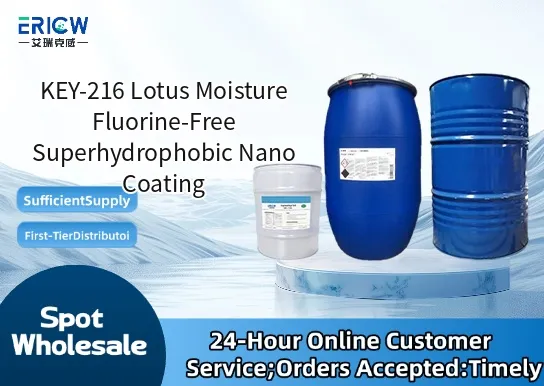
Fluorine-free formulation ensures compliance with global PFAS restrictions and supports sustainable manufacturing goals.
Nano-engineered silica-based architecture delivers robust superhydrophobicity (water contact angle >150°) without fluorinated chemistry.
Moisture-triggered self-assembly enables rapid, ambient-cure film formation on diverse substrates.
Exceptional chemical resistance to neutral aqueous solutions, mild acids, and aliphatic hydrocarbons.
Low VOC (<50 g/L) and solvent-free aqueous dispersion format enhances workplace safety and EHS profile.
Protective topcoat for architectural façades, precast concrete, and natural stone surfaces.
Water-repellent treatment for textile substrates in technical apparel and outdoor gear.
Functional coating for electronic enclosures, sensor housings, and PCB edge protection.
Hydrophobic barrier layer for paperboard packaging in food-contact-adjacent applications.
Surface modification of ceramic tiles, glass, and anodized aluminum in interior design elements.
| Chemical Type | Nano-silica hybrid colloid (non-fluorinated) |
| Product Form | Aqueous colloidal dispersion |
| Appearance | Translucent milky liquid, slight opalescence |
| pH (1% w/w in DI water) | 8.2 – 8.7 |
| Primary Applications | Superhydrophobic surface protection, moisture barrier enhancement |
| Key Features | Fluorine-free, ambient-cure, nanostructured, self-assembling |
| Benefits | Reduced environmental footprint, simplified regulatory documentation, compatibility with ISO 14001 systems |
| Regulatory Compliance | REACH SVHC-free; compliant with EU Directive 2013/39/EU (priority substances); no listed PFAS per OECD definition |
| Common Compatible Systems | Suitability |
| Water-based acrylic primers and sealers | Highly Recommended – Excellent intercoat adhesion and coalescence stability |
| UV-curable acrylate topcoats (low-acid type) | Recommended – Requires 24 h KEY-216 cure prior to UV overcoat |
| Electrostatic powder coatings (epoxy-polyester hybrids) | Suitable – Use as pretreatment after curing and cooling; verify surface energy compatibility |
| Industrial solvent-based polyurethane clearcoats | Not Recommended – Risk of dispersion destabilization and haze formation |
Q1: What is the CAS Registry Number for KEY-216?
A: KEY-216 is a proprietary multi-component nanodispersion; individual constituents are disclosed under confidentiality agreement, and the formulation does not carry a single CAS number. Full compositional disclosure is available under NDA for regulatory submissions.
Q2: What is the recommended application dosage for optimal performance?
A: For dip-coating or spray application, target dry-film thickness of 0.8–1.2 µm; typical usage is 8–12 g/m² (as supplied). Exact dosage depends on substrate porosity and desired contact angle — validation testing is advised for critical applications.
Q3: How does KEY-216 differ from fluorinated superhydrophobic alternatives like KEY-215F?
A: KEY-216 replaces perfluoroalkyl chains with tailored siloxane–polyether amphiphiles, eliminating persistent bioaccumulative potential while retaining >148° static water contact angle and comparable roll-off performance under standard test conditions (ASTM D7334).
Q4: Has KEY-216 undergone migration or extraction testing for food-contact-adjacent use?
A: Yes — tested per EU Regulation (EC) No. 10/2011 Annex V: no detectable migration (<0.01 mg/kg) of non-volatile components into 10% ethanol, 3% acetic acid, and olive oil simulants at 40°C for 10 days (validated by SGS Lab Report #K216-MIG-2024-0892).
Contact With Us:
E-mail: wangxingqiang@ericwchem.com
Have a Questions? Call Us:
Add:
Building A1, Jiete Industrial Park, Huangpu District, Guangzhou City, Guangdong Province, China