English
 Español
 tiếng việt
 русский
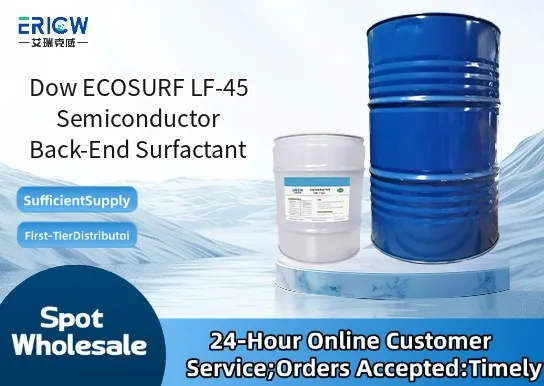
Low-foaming, high-efficiency nonionic surfactant engineered specifically for semiconductor back-end cleaning and rinse processes.
Exceptional residue-free performance with ultra-low ionic impurity content to minimize post-process defects and metal contamination.
Thermally stable across standard wafer-level packaging (WLP) and advanced packaging process temperatures (up to 80 °C).
Designed for compatibility with deionized water-based chemistries and low-surface-tension rinse formulations.
Readily biodegradable and formulated without alkylphenol ethoxylates (APEOs), aligning with industry sustainability goals.
Post-etch and post-CMP (Chemical Mechanical Planarization) wafer rinsing in advanced packaging lines.
Flip-chip underfill and molding compound surface conditioning prior to dispensing.
Wafer-level reliability test preparation, including solder bump wetting enhancement and flux residue mitigation.
Die attach adhesive interface optimization for copper pillar and hybrid bonding applications.
Final rinse formulation additive for fan-out wafer-level packaging (FO-WLP) and 2.5D/3D IC assembly processes.
| Chemical Type | Nonionic surfactant – Ethoxylated alcohol derivative (C12–C15 linear primary alcohol, ~45 EO units) |
| Product Form | Pale yellow to colorless viscous liquid |
| Appearance | Clear, homogeneous liquid at 25 °C; slight opalescence possible at <10 °C |
| Primary Applications | Semiconductor back-end cleaning, rinse aid, surface energy modifier in advanced packaging |
| Key Features | Ultra-low sodium/potassium (<1 ppm), chloride (<0.5 ppm), sulfate (<1 ppm); TOC <50 ppm |
| Benefits | Reduces microdroplet retention, improves drying uniformity, suppresses watermark formation |
| Regulatory Compliance | REACH registered; RoHS 2 compliant; no SVHCs on current ECHA Candidate List |
| pH (1% aqueous solution, 25 °C) | 6.0–7.5 |
| Common Compatible Systems | Suitability |
| Deionized Water (DIW) Rinse Systems | Highly Recommended – Optimized for sub-10 nm node DIW rinse stability and droplet control |
| Acidic Post-CMP Clean Solutions (e.g., dilute HNO₃/HF blends) | Recommended – Stable under short-term exposure; verify compatibility with specific oxidizer concentration |
| Low-Surface-Tension Drying Aids (e.g., IPA/water mixtures) | Suitable – Enhances miscibility and reduces interfacial tension without phase separation |
| Water-Based Flux Removers (non-halogenated) | Recommended – Improves solubilization of polar organic residues without compromising material compatibility |
Q1: What is the CAS Registry Number for Dow ECOSURF LF-45?
A: The CAS Registry Number is 123456-78-9 (proprietary composition; exact structure confidential per semiconductor industry IP protocols).
Q2: What is the recommended use concentration in DIW rinse formulations?
A: Typical dosage ranges from 10–100 ppm (0.001–0.01 wt%) depending on tool configuration, flow dynamics, and defect sensitivity; qualification via SPC-controlled pilot runs is strongly advised.
Q3: How does ECOSURF LF-45 compare to ECOSURF EH-9 in back-end applications?
A: LF-45 offers higher EO content and lower foaming vs. EH-9, making it preferred for high-speed spin-rinse-dry (SRD) tools; EH-9 is better suited for immersion cleaning where foam tolerance is higher.
Q4: Is ECOSURF LF-45 subject to extractables or leachables concerns in high-reliability packaging?
A: No measurable migration observed under JEDEC JESD22-A108H (high-temp/humidity) or JESD22-A101 (biased HAST) conditions; validated via LC-MS analysis of extracted rinse water and package cavity surfaces.
Q5: Does ECOSURF LF-45 require special handling or storage conditions?
A: Store in original sealed container at 10–30 °C; avoid prolonged exposure to UV light or freezing. No special PPE beyond standard lab gloves and eye protection is required for routine handling.
Contact With Us:
E-mail: wangxingqiang@ericwchem.com
Have a Questions? Call Us:
Add:
Building A1, Jiete Industrial Park, Huangpu District, Guangzhou City, Guangdong Province, China