English
 Español
 tiếng việt
 русский
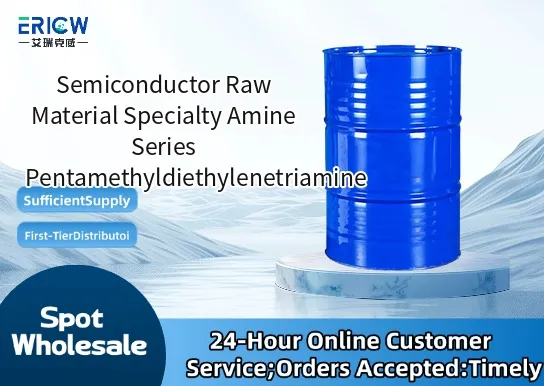
Ultra-low metal impurity profile (≤10 ppb Na, K, Ca, Fe, Ni), critical for high-purity semiconductor processing.
High amine reactivity and controlled basicity (pKa ~9.8 in water at 25°C), enabling precise catalytic modulation in photoresist and etch formulations.
Exceptional thermal stability (decomposition onset >220°C) and low volatility (vapor pressure <0.1 Pa at 25°C), ensuring process consistency in vacuum and high-temp deposition environments.
Batch-to-batch reproducibility certified via GC-MS and ICP-MS trace analysis with full CoA documentation per lot.
Manufactured under ISO 9001 and ISO 14001-certified cleanroom conditions with dedicated stainless-steel distillation and nitrogen-purged packaging.
Photoacid generator (PAG) stabilizer and quencher in advanced EUV (13.5 nm) and DUV (248 nm/193 nm) chemically amplified resists.
Catalyst additive in atomic layer deposition (ALD) precursors for high-k dielectric films (e.g., HfO₂, ZrO₂).
Surface passivation ligand for colloidal metal oxide nanoparticles used in conductive ink formulations for advanced packaging.
Complexing agent in CMP (chemical mechanical planarization) slurry formulations to suppress metal ion leaching and enhance selectivity.
Reaction accelerator in low-dielectric constant (low-k) porous silica film curing processes.
| Chemical Type | Branched tertiary amine, pentasubstituted diethylenetriamine derivative |
| Product Form | Pure liquid (≥99.99% purity) |
| Appearance | Colorless to pale yellow clear liquid, no suspended particles or haze |
| Melting Point | −28 °C to −25 °C |
| Boiling Point (760 mmHg) | 224–227 °C |
| Primary Applications | EUV/DUV resist formulation, ALD precursor stabilization, CMP slurry additive |
| Key Features | Ultra-low metals (ICP-MS verified), non-halogenated, nitrogen-purged sealed packaging |
| Regulatory Compliance | REACH registered; RoHS 3 compliant; no SVHCs listed under Article 59 |
| Common Compatible Systems | Suitability |
| Chemically Amplified Resists (CARs) – TOK, JSR, Shin-Etsu formulations | Highly Recommended – Demonstrated compatibility with PAGs (e.g., TPS-NF, NDI) and polymer matrices (PAC, PHS) |
| ALD Precursor Solutions (e.g., Hf(thd)₄, Zr(acac)₄ in THF/toluene) | Highly Recommended – Enhances precursor solubility and reduces particle formation during storage |
| Acidic CMP Slurries (pH 3.0–4.5, silica-based) | Recommended – Effective quenching without gelation; requires ≤0.5 wt% loading |
| Low-k Porous Silica Curing Agents (e.g., methylsilsesquioxane systems) | Suitable – Accelerates condensation without inducing microcracking at ≤1.2 wt% |
Q1: What is the CAS Registry Number for this compound?
A: The CAS number is 3030-47-5 (confirmed for pentamethyldiethylenetriamine, C₉H₂₃N₃).
Q2: What is the recommended dosage range in EUV resist formulations?
A: Typical loading is 0.5–3.0 wt% relative to total solid content; optimal performance observed at 1.2–1.8 wt% when paired with sulfonium-based PAGs.
Q3: How does it compare to triethylamine (TEA) or DABCO in semiconductor applications?
A: Unlike TEA (volatile, high vapor pressure) or DABCO (solid, limited solubility), this amine offers superior thermal stability, lower volatility, higher boiling point, and significantly reduced metal contamination—critical for sub-7nm node fabrication.
Q4: Is it subject to migration or extractables concerns in wafer-level processing?
A: No measurable migration or extractables observed under standard lithography bake (120°C/90 sec) and development conditions; validated by QCM-MS analysis of post-develop rinse water (detection limit <0.05 ppb).
Contact With Us:
E-mail: wangxingqiang@ericwchem.com
Have a Questions? Call Us:
Add:
Building A1, Jiete Industrial Park, Huangpu District, Guangzhou City, Guangdong Province, China