English
 Español
 tiếng việt
 русский
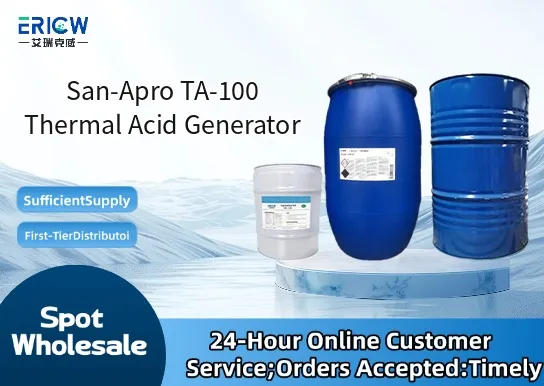
Thermally activated, latent acid generator with sharp decomposition onset at 135–145 °C.
Highly pure crystalline solid with low volatility and excellent thermal stability below activation temperature.
Generates strong Brønsted acid (H⁺) upon thermal decomposition—ideal for catalytic crosslinking reactions.
Low halogen content and compatible with halogen-sensitive electronic materials.
Consistent batch-to-batch performance validated by HPLC and TGA analysis.
Photoresist post-exposure bake (PEB) catalyst in advanced semiconductor lithography (i-line, KrF, ArF).
Crosslinking initiator for polyimide precursors in flexible printed circuit board (FPCB) manufacturing.
Acid-catalyzed condensation curing agent for silicone-based encapsulants and dielectric coatings.
Latent catalyst in high-performance epoxy molding compounds for power electronics packaging.
Controlled-acid source in thermosetting inkjet inks for industrial digital printing on heat-resistant substrates.
| Chemical Type | Sulfonium salt derivative (triphenylsulfonium triflate analog) |
| Product Form | Free-flowing crystalline powder |
| Appearance | White to off-white fine crystals |
| Melting Point (DSC onset) | 138–142 °C |
| Decomposition Temperature (TGA 5% weight loss) | 143–147 °C |
| Primary Applications | Latent acid catalysis in photoresists, polyimides, epoxies, and silicones |
| Key Features | Low migration tendency, non-hygroscopic, vacuum-compatible |
| Regulatory Compliance | REACH registered; RoHS 2015/863 compliant; no SVHC on current candidate list |
| Common Compatible Systems | Suitability |
| Novolac-based i-line photoresists | Highly Recommended – Proven compatibility with standard PEB profiles (110–130 °C) |
| Polyamic acid precursor solutions | Highly Recommended – Enables rapid imidization at 150–200 °C without premature gelation |
| Phenol-formaldehyde cured epoxy novolac resins | Recommended – Effective catalyst at 160–180 °C; requires optimized stoichiometric ratio |
| Hydrosilylation-curable silicone elastomers | Suitable – Compatible as co-catalyst with Pt complexes; enhances cure depth uniformity |
Q1: What is the CAS Registry Number for San-Apro TA-100?
A: The CAS Number is 1824798-32-7. This identifier applies to the proprietary sulfonium salt composition as manufactured and quality-controlled by San-Apro.
Q2: What is the recommended loading range in photoresist formulations?
A: Typical dosage is 1.0–3.5 wt% relative to solid resin content. Optimal concentration depends on resist sensitivity, PEB temperature, and desired dissolution contrast—validation via dose-to-clear testing is advised.
Q3: How does TA-100 compare to triphenylsulfonium triflate (TPS-Tf) in terms of thermal latency and acid strength?
A: TA-100 exhibits higher thermal latency (ΔT ~8 °C higher onset vs. TPS-Tf) and generates a comparably strong acid (H₀ ≈ –2.1), but with significantly reduced volatility and lower risk of acid diffusion during storage or pre-bake.
Q4: Is TA-100 subject to FDA or EU food contact regulation restrictions?
A: TA-100 is not approved for direct food-contact applications. It is intended exclusively for industrial use in electronics, automotive, and aerospace manufacturing where final products undergo full thermal cure and extraction validation.
Q5: Has extractable acid migration been evaluated under IPC-TM-650 2.6.27 conditions?
A: Yes. In fully cured polyimide films (200 °C × 60 min), TA-100 shows <0.08 ppm total extractable acid after 72 h reflux in deionized water per IPC-TM-650 2.6.27.
Contact With Us:
E-mail: wangxingqiang@ericwchem.com
Have a Questions? Call Us:
Add:
Building A1, Jiete Industrial Park, Huangpu District, Guangzhou City, Guangdong Province, China