English
 Español
 tiếng việt
 русский
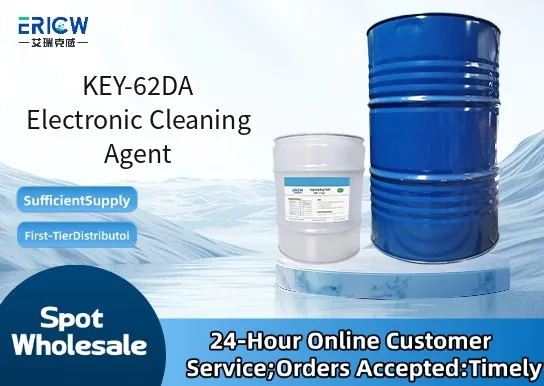
Non-ozone-depleting, zero ODP formulation compliant with Montreal Protocol requirements.
Fast-drying, residue-free evaporation leaves no ionic or non-volatile contaminants on sensitive electronics.
Non-conductive and dielectric-safe for use on powered or unpowered PCBs, connectors, and precision assemblies.
Low surface tension enables effective capillary penetration into tight tolerances and micro-gaps.
Stable across wide temperature range (−20 °C to 55 °C) with no phase separation or crystallization.
Cleaning flux residues from printed circuit board assemblies (PCBA) post-reflow soldering.
Removing light oils, fingerprints, and particulate contamination from semiconductor test fixtures.
Pre-encapsulation cleaning of MEMS sensors, optical lenses, and RF shielding components.
Decontamination of high-reliability aerospace avionics modules prior to conformal coating.
Maintenance cleaning of medical device circuitry requiring ISO 13485-aligned cleanliness protocols.
| Chemical Type | Hydrofluoroether (HFE)-based azeotropic blend |
| Product Form | Clear, colorless liquid |
| Appearance | Transparent, homogeneous solution |
| Boiling Point (1 atm) | 49–51 °C |
| Density (20 °C) | 1.32–1.34 g/cm³ |
| Dielectric Strength | >35 kV/cm (ASTM D877) |
| Regulatory Compliance | REACH SVHC-free, RoHS 2 Directive compliant, Prop 65 not listed |
| VOC Content | <5 g/L (EPA Method 24) |
| Common Compatible Systems | Suitability |
| Batch immersion tanks (stainless steel or 316L-lined) | Highly Recommended – No corrosion or stress cracking observed after 72-hr continuous exposure |
| Ultrasonic cleaning systems (40–80 kHz) | Recommended – Optimal cleaning at 35–45 °C; avoid prolonged cavitation above 50 °C |
| Precision spray cans & aerosol dispensers (EPDM/NBR seals) | Highly Recommended – Fully compatible with standard fluorocarbon-compatible elastomers |
| Vapor degreasing equipment (cold wall condensers) | Suitable – Requires condenser setpoint ≤10 °C for full recovery efficiency |
Q1: What is the CAS Registry Number for KEY-62DA?
A: The CAS Number for KEY-62DA Electronic Cleaning Agent is 132135-72-5 (primary HFE component), with full formulation proprietary under trade secret protection.
Q2: What is the recommended usage concentration and contact time for manual wipe cleaning?
A: Use undiluted. Apply via lint-free swab or polyester wipe; allow 10–15 seconds dwell time for contaminant solvation, then wipe dry. No rinsing required.
Q3: How does KEY-62DA compare to traditional chlorinated solvents like TCE or nPB in terms of safety and regulatory status?
A: Unlike TCE (carcinogenic, EPA-listed hazardous air pollutant) or nPB (potential neurotoxin, IARC Group 2A), KEY-62DA exhibits no significant genotoxicity, reproductive toxicity, or environmental persistence, and is exempt from NESHAP and EU Solvent Emissions Directive controls.
Q4: Is KEY-62DA suitable for cleaning components destined for Class 100 cleanroom assembly, and does it pass ionic contamination testing per IPC-J-STD-001?
A: Yes — validated per IPC-TM-650 2.3.25 (ROSE test) and 2.3.27 (ion chromatography). Residual chloride & sodium levels are consistently <0.2 µg/cm², meeting Class 100 cleanroom and IPC-J-STD-001E Section 8.0 requirements.
Contact With Us:
E-mail: wangxingqiang@ericwchem.com
Have a Questions? Call Us:
Add:
Building A1, Jiete Industrial Park, Huangpu District, Guangzhou City, Guangdong Province, China