English
 Español
 tiếng việt
 русский
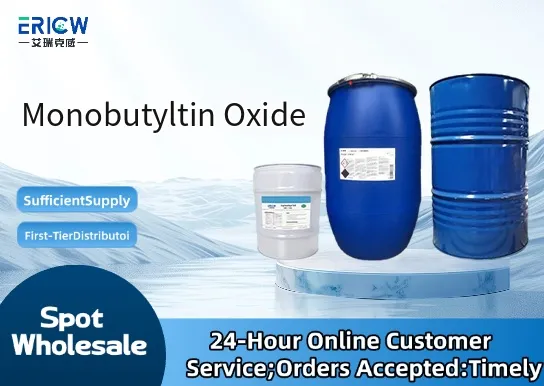
High thermal stability suitable for high-temperature polymer processing.
Excellent catalytic activity in esterification and transesterification reactions.
Low volatility and reduced vapor pressure compared to dialkyltin compounds.
Good compatibility with PVC and polyurethane systems without compromising clarity.
Controlled reactivity enables precise process timing in coating and adhesive formulations.
PVC heat stabilizer — particularly effective in rigid profiles and pipes.
Catalyst for silicone curing (condensation-type RTV and LSR systems).
Intermediate in the synthesis of organotin-based biocides and agrochemicals.
Crosslinking agent for alkyd resins and moisture-cure polyurethane coatings.
Additive in specialty sealants requiring low migration and long-term hydrolytic stability.
| Chemical Type | Organotin compound (monoalkyltin oxide) |
| Chemical Name | Monobutyltin(IV) oxide |
| CAS Number | 818-08-6 |
| Product Form | White to off-white crystalline powder |
| Appearance | Free-flowing, non-hygroscopic powder |
| Melting Point | Decomposes above 220 °C (no sharp melting point) |
| Assay (as C₄H₉SnO) | ≥ 97.0% (by GC or titration) |
| Residue on Ignition | ≤ 0.5% (as SnO₂) |
| Common Compatible Systems | Suitability |
| Rigid PVC formulations (e.g., window profiles, pipes) | Highly Recommended – Provides synergistic stabilization with calcium-zinc soaps; low discoloration risk. |
| Condensation-cure silicone elastomers (RTV-1/RTV-2) | Highly Recommended – Efficient catalyst for alkoxy- and acetoxy-silane crosslinking. |
| Alkyd resin-based baking enamels | Recommended – Enhances cure speed without excessive brittleness. |
| Moisture-cure polyurethane adhesives | Suitable – Effective at low loadings (0.05–0.2 phr); requires formulation optimization for pot life control. |
Q1: What is the CAS number for Monobutyltin Oxide?
A: The CAS Registry Number for Monobutyltin Oxide is 818-08-6.
Q2: What is the typical usage level in PVC heat stabilization?
A: In combination with co-stabilizers (e.g., Ca/Zn soaps), recommended dosage ranges from 0.3 to 1.2 parts per hundred resin (phr), depending on processing temperature and end-use requirements.
Q3: How does Monobutyltin Oxide compare to Dibutyltin Oxide in terms of regulatory acceptance and migration potential?
A: Monobutyltin Oxide exhibits significantly lower bioaccumulation potential and reduced leaching in food-contact applications versus dibutyltin analogues; it is not classified as a Substance of Very High Concern (SVHC) under EU REACH, and meets FDA 21 CFR §178.2010 for indirect food additives when used within specified limits.
Q4: Is Monobutyltin Oxide compliant with RoHS and ELV directives?
A: Yes — Monobutyltin Oxide contains no restricted heavy metals (Pb, Cd, Hg, Cr⁶⁺) and is exempt from RoHS Annex II concentration limits for tin compounds; it complies with ELV Directive 2000/53/EC for automotive applications when used below 0.1 wt% in homogeneous materials.
Contact With Us:
E-mail: wangxingqiang@ericwchem.com
Have a Questions? Call Us:
Add:
Building A1, Jiete Industrial Park, Huangpu District, Guangzhou City, Guangdong Province, China