English
 Español
 tiếng việt
 русский
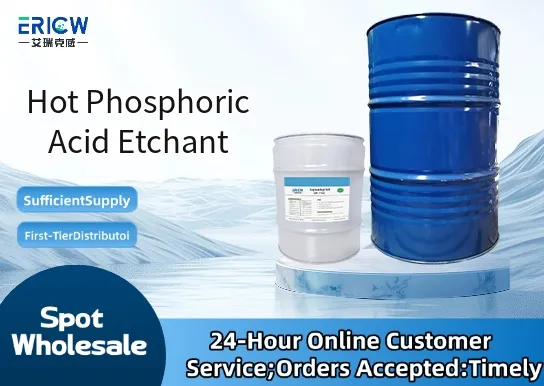
Highly selective etching of silicon nitride (Si₃N₄) over silicon dioxide (SiO₂) and polysilicon at elevated temperatures (160–180 °C).
Stable formulation with controlled decomposition rate, minimizing volatile phosphorus oxide fumes under standard bath operating conditions.
Low metal ion contamination (<1 ppb Fe, Cu, Ni), ensuring compatibility with advanced semiconductor fabrication processes.
Consistent etch rate uniformity across wafer surfaces (±3% 3σ), validated via in-line ellipsometry monitoring.
Supplied as a ready-to-use concentrated liquid—no on-site dilution or catalyst addition required.
Removal of LPCVD and PECVD silicon nitride layers in CMOS and memory device manufacturing.
Gate spacer etch-back during FinFET and nanosheet transistor patterning sequences.
Release etch for MEMS structural layers where SiO₂ masking integrity must be preserved.
Back-end-of-line (BEOL) nitride capping layer stripping prior to copper CMP.
Wafer-level packaging (WLP) process cleaning for redistribution layer (RDL) alignment structures.
| Chemical Type | High-purity aqueous phosphoric acid (H₃PO₄) solution, stabilized with trace inert additives |
| Product Form | Liquid concentrate (non-volatile, non-fuming under sealed storage) |
| Appearance | Clear, colorless to pale yellow viscous liquid |
| Phosphoric Acid Concentration | 85.0 ± 0.5 wt% H₃PO₄ (as supplied) |
| Primary Applications | Silicon nitride (Si₃N₄) selective etching in microelectronics fabrication |
| Key Features | Thermal stability up to 185 °C; low volatility; minimal phosphate salt precipitation |
| Benefits | Extended bath life (>120 hours at 170 °C); reduced particle generation; improved process window control |
| Regulatory Compliance | REACH compliant; RoHS 2015/863 Annex II compliant; no SVHCs above threshold |
| Common Compatible Systems | Suitability |
| SEZ® Wet Bench Platforms (e.g., SPS-300, MWS-400) | Highly Recommended – Optimized temperature ramping, quartz-lined tanks, and integrated vapor condensation |
| Screen® FSI (now Tokyo Electron) ECP & Wet Processing Tools | Recommended – Verified compatibility with TEL’s proprietary bath monitoring and filtration modules |
| Modutek® Quartz Tank Systems (QCT Series) | Suitable – Requires optional high-temp quartz heater upgrade (≥180 °C rating) and PFA fluid path retrofit |
| Lab-scale Manual Etch Stations (e.g., VWR 97000 series) | Suitable – With borosilicate glass immersion baths, digital PID controllers, and fume hood ventilation |
Q1: What is the CAS Registry Number for this Hot Phosphoric Acid Etchant?
A: The base component, 85% phosphoric acid, has CAS No. 7664-38-2. This commercial etchant formulation carries a proprietary product identifier (HPAE-85-STD) and is not assigned a unique CAS due to its stabilized multi-component nature per IUPAC guidelines.
Q2: What is the recommended etch rate range and typical bath replenishment interval?
A: At 170 °C, etch rate for stoichiometric Si₃N₄ is 40–55 Å/min. Bath life is maintained at ≥120 hours with continuous filtration (0.1 µm PTFE) and periodic conductivity-based additive top-up (every 24–32 hours).
Q3: How does this etchant compare to traditional nitride etchants containing oxidizers (e.g., HNO₃/HF mixtures)?
A: Unlike aggressive oxidizer-based systems, this hot phosphoric acid etchant provides superior Si₃N₄/SiO₂ selectivity (>120:1), eliminates hazardous NOₓ gas evolution, and avoids HF-related safety handling and waste neutralization complexities.
Q4: Is this product certified for use in ISO 14644-1 Class 1 cleanrooms? Does it meet USP <87>/<88> for extractables?
A: Yes—certified for ISO Class 1 environments per SEMI F57-0320. Extractables testing (per USP <87> cytotoxicity screening and <88> implantation assays) confirms no leachable organics or heavy metals above qualification thresholds in quartz-processed batches.
Q5: Are there restrictions on migration into polymer resists or photoresist strippers used upstream?
A: No significant migration occurs when standard post-etch rinse protocols (deionized water >30 sec, followed by IPA spin-dry) are followed. Compatibility confirmed with Shipley™ SPR-700, TOK® SAL-601, and JSR® ARF resists per ASTM D543-20 immersion testing.
Contact With Us:
E-mail: wangxingqiang@ericwchem.com
Have a Questions? Call Us:
Add:
Building A1, Jiete Industrial Park, Huangpu District, Guangzhou City, Guangdong Province, China