English
 Español
 tiếng việt
 русский
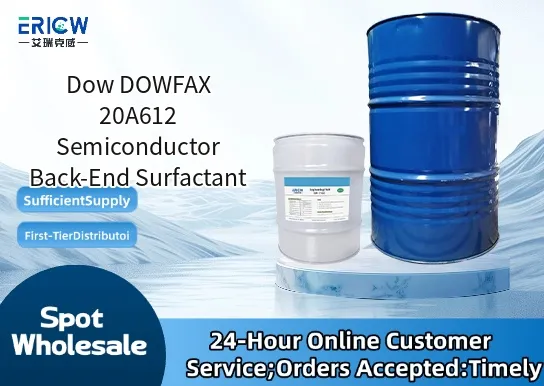
Ultra-low residue profile optimized for post-CMP cleaning and wafer back-end-of-line (BEOL) processing.
Exceptional compatibility with advanced photoresists and low-k dielectric materials, minimizing pattern collapse and surface defects.
Highly effective at reducing static charge accumulation during rinse/dry steps, lowering particle re-adhesion risk.
Engineered for rapid, uniform rinsing with minimal foaming in high-throughput semiconductor wet benches.
Stable performance across a broad pH range (pH 4–9) and compatible with deionized water-based chemistries.
Post-chemical mechanical polishing (post-CMP) wafer cleaning for copper/low-k interconnect structures.
Rinse additive in BEOL cleaning formulations for advanced logic and memory devices (≤5 nm node).
Surface energy modifier in spin-rinse-dry (SRD) processes to improve drying uniformity and reduce watermark formation.
Residue suppression agent in etch residue removal formulations for organic-based dielectric stacks.
Performance enhancer in ultra-low-surface-tension rinse solutions for 3D NAND and advanced packaging substrates.
| Chemical Type | Anionic surfactant — branched alkyl ether sulfate |
| Product Form | Aqueous solution (~30% active) |
| Appearance | Clear, colorless to pale yellow liquid |
| pH (1% aqueous solution, 25°C) | 6.5 – 7.5 |
| Primary Applications | Semiconductor back-end cleaning, post-CMP rinse, BEOL defect control |
| Key Features | Low ionic impurity content, ultra-low sodium/calcium/metal residuals, non-volatile residue <1 ppm (per SEMI F57) |
| Benefits | Enables high yield in Cu/low-k integration; supports <10 nm feature patterning; reduces DI water consumption |
| Regulatory Compliance | REACH registered; RoHS compliant; no SVHCs per current ECHA Candidate List |
| Common Compatible Systems | Suitability |
| Standard DI water rinse modules (e.g., Tokyo Electron, Lam Research SRD tools) | Highly Recommended – Optimized for flow-through and spray-rinse configurations |
| Acidic post-etch rinse formulations (e.g., dilute SC1 variants) | Recommended – Stable under mild oxidative conditions; avoid strong oxidizers (e.g., >1% H₂O₂) |
| Low-surface-tension solvent blends (e.g., isopropanol/water mixtures) | Suitable – Enhances miscibility and evaporation uniformity without phase separation |
| Photoresist-compatible neutral cleaners (e.g., G-line/I-line resist-safe chemistries) | Highly Recommended – Demonstrated non-swelling behavior on common novolac and CAR resists |
Q1: What is the CAS Registry Number for DOWFAX 20A612?
A: The CAS Registry Number is 10115-95-4 (generic for branched C12–C15 alkyl ether sulfates; product-specific batch certification available upon request).
Q2: What is the typical use concentration in semiconductor rinse applications?
A: Recommended dosage is 0.05–0.2 wt% in deionized water; optimal concentration is process- and tool-dependent and should be validated via particle count and surface analysis (e.g., SEMI F39).
Q3: How does DOWFAX 20A612 compare to traditional linear alkylbenzene sulfonates (LAS) in BEOL applications?
A: Unlike LAS, DOWFAX 20A612 features branched ether sulfate chemistry with superior biodegradability, lower critical micelle concentration (CMC), and significantly reduced metal ion complexation—critical for preventing Cu contamination and low-k damage.
Q4: Is DOWFAX 20A612 subject to outgassing or extractables concerns in vacuum or high-temp BEOL processes?
A: No measurable volatile organic compounds (VOCs) or silicon-containing extractables were detected per SEMI F57 testing; thermal stability exceeds 120°C (short-term exposure), and it leaves no detectable carbon residue after 300°C N₂ bake.
Contact With Us:
E-mail: wangxingqiang@ericwchem.com
Have a Questions? Call Us:
Add:
Building A1, Jiete Industrial Park, Huangpu District, Guangzhou City, Guangdong Province, China