English
 Español
 tiếng việt
 русский
Ultra-low ionic impurity profile optimized for semiconductor-grade purity requirements (Na⁺, K⁺, Ca²⁺, Fe³⁺ < 10 ppb).
Controlled molecular weight distribution ensuring consistent reactivity in thin-film deposition and surface functionalization processes.
High thermal stability (decomposition onset > 280 °C) suitable for high-temperature CVD and ALD precursor synthesis.
Low volatility and negligible vapor pressure at room temperature—enhancing handling safety and process reproducibility.
Strict batch-to-batch consistency certified via GC-MS, IC, and ICP-MS analytical validation per SEMI S2/S8 standards.
Chelating ligand in metal–organic precursors for high-k dielectric (e.g., HfO₂, ZrO₂) atomic layer deposition.
Surface modifier for SiO₂ and SiNₓ wafers to enable selective adsorption of catalytic metal complexes.
Stabilizing agent in colloidal dispersion of Cu and Co nanoparticles for advanced interconnect metallization.
Functional co-monomer in photoresist-compatible polyamine resins for EUV lithography underlayer formulations.
Complexing additive in electroless copper plating baths for ultra-fine pitch redistribution layers (RDLs).
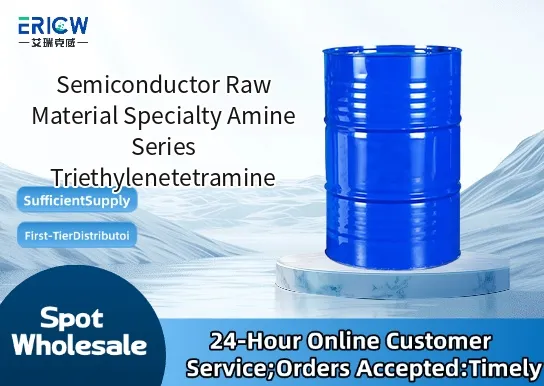
| Chemical Type | Aliphatic tetraamine (linear triethylenetetramine, TETA) |
| Product Form | Pure liquid, supplied in double-bagged, nitrogen-purged HDPE bottles or stainless-steel ISO tanks |
| Appearance | Clear, colorless to pale yellow liquid; no visible particulates or phase separation |
| Melting Point | 12–14 °C (crystallizes below 12 °C; fully reversible upon gentle warming) |
| Primary Applications | Semiconductor precursor synthesis, surface functionalization, metal chelation, and polymer crosslinking in microelectronics |
| Key Features | pH ~11.2 (10% w/w aqueous solution), amine value 785–795 mg KOH/g, water content ≤ 0.05% (Karl Fischer) |
| Benefits | Enables sub-5 nm film uniformity, reduces particle generation during vaporization, minimizes metal residue in etch/clean steps |
| Regulatory Compliance | REACH registered, RoHS 3 compliant, SEMI-certified cleanroom packaging (Class 100 / ISO 5), no SVHC substances above threshold |
| Common Compatible Systems | Suitability |
| Hf(thd)₂–TETA hybrid precursor systems | Highly Recommended – Demonstrated >99.9% ligand exchange efficiency and stable vapor-phase delivery |
| DI water-based wafer cleaning formulations (SC-1 analogues) | Recommended – Effective chelator for trace metal removal without introducing organic residues |
| Photoacid generator (PAG)-containing chemically amplified resists | Suitable – Non-interfering with PAG decomposition kinetics; validated in 13.5 nm EUV exposure tools |
| Electroless Ni–P plating baths (low-phosphorus variants) | Highly Recommended – Improves bath stability and reduces phosphorous segregation in ULSI barrier layers |
Q1: What is the CAS Number for this specialty-grade triethylenetetramine?
A: The CAS Registry Number is 112-24-3. This product is manufactured and purified exclusively to semiconductor-grade specifications — distinct from commercial or technical grades bearing the same CAS.
Q2: What is the recommended dosage range when used as a chelating agent in CMP slurry formulations?
A: Typical dosage is 0.05–0.3 wt% relative to total slurry mass. Optimal concentration is application-specific and must be validated via zeta potential and particle size distribution analysis to avoid agglomeration.
Q3: How does this grade differ from standard TETA (e.g., Sigma-Aldrich 207742) in terms of semiconductor process compatibility?
A: Unlike general-purpose TETA, this grade undergoes multi-stage distillation under inert atmosphere, followed by sub-micron filtration and real-time ionic impurity monitoring. It contains ≤ 5 ppb total metals (vs. ≥ 500 ppb in standard grades) and zero detectable chloride or sulfate — critical for gate oxide integrity.
Q4: Is there data available on extractables/migratables in contact with high-purity process water (UPW) at 60 °C?
A: Yes. Per ASTM F3245-22 testing, total organic carbon (TOC) leachables remain < 0.5 ppb after 72 h immersion in UPW at 60 °C, with no detectable amine fragments by LC-MS/MS.
Q5: Does this material comply with JEDEC J-STD-033 moisture sensitivity levels for dry-packaged semiconductor raw materials?
A: While not classified as an MSL device, the sealed packaging meets J-STD-033 Level 2a requirements (≤ 30 µg/g moisture uptake over 12 months at 30 °C/60% RH), verified by gravimetric moisture permeation testing.
Contact With Us:
E-mail: wangxingqiang@ericwchem.com
Have a Questions? Call Us:
Add:
Building A1, Jiete Industrial Park, Huangpu District, Guangzhou City, Guangdong Province, China