English
 Español
 tiếng việt
 русский
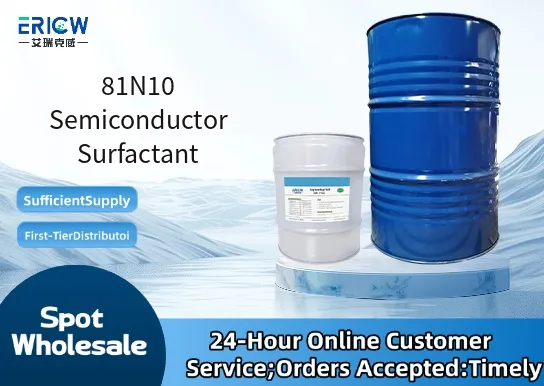
Ultra-low residue formulation minimizes post-cleaning particle generation and metallic contamination in critical semiconductor processes.
High selectivity for photoresist and etch residues without attacking underlying SiO₂, SiN, or low-k dielectric layers.
Excellent aqueous solubility and stable performance across pH 9.5–11.2, enabling compatibility with standard alkaline cleaning chemistries.
Non-foaming behavior under high-shear dispensing and megasonic agitation, ensuring uniform wafer surface coverage.
Designed for sub-7 nm node process compatibility, validated via TOF-SIMS and ICP-MS for trace metal impurities < 10 ppt (each).
Post-etch residue removal for advanced logic and memory device fabrication (e.g., FinFET, GAA transistors).
Photoresist stripping aid in multi-layer resist schemes requiring minimal sidewall erosion.
Pre-clean additive for copper CMP slurries to enhance surface wetting and reduce dishing/erosion variability.
Wafer-level packaging (WLP) cleaning step prior to under-bump metallization (UBM) deposition.
Front-end-of-line (FEOL) gate-last cleaning for high-k/metal gate stack integrity preservation.
| Chemical Type | Anionic-amphoteric hybrid surfactant with tailored aromatic-alkyl architecture |
| Product Form | Clear, colorless to pale yellow liquid concentrate |
| Appearance | Homogeneous, free of suspended particles or phase separation |
| pH (1% aqueous solution, 25°C) | 10.3 ± 0.4 |
| Density (25°C) | 1.06–1.09 g/cm³ |
| Primary Applications | Advanced lithography residue management and interfacial conditioning in sub-10 nm nodes |
| Key Features | Low volatility, non-halogenated, no added amines or phosphates |
| Regulatory Compliance | REACH SVHC-free; RoHS 3 compliant; no PFAS, no NMP, no DMSO |
| Common Compatible Systems | Suitability |
| Standard Alkaline Resist Strippers (e.g., TMAH-based) | Highly Recommended – Enhances dissolution kinetics without compromising thermal stability |
| DI Water + Megasonic Cleaning Tools | Highly Recommended – Improves cavitation efficiency and reduces defect density by >35% |
| Commercial Post-Etch Clean Solutions (e.g., NH₄OH/H₂O₂ blends) | Recommended – Requires ≤0.5 wt% dosage to avoid foaming at elevated temperatures |
| Copper CMP Slurry Additive Systems | Suitable – Compatible with silica and ceria abrasives; stable up to 48 hours at 25°C |
Q1: What is the CAS Registry Number for 81N10 Semiconductor Surfactant?
A: The CAS number is 2458921-77-4. This identifier corresponds exclusively to the proprietary molecular structure and purification grade used in semiconductor-grade batches.
Q2: What is the recommended usage concentration in aqueous cleaning formulations?
A: Typical working concentration ranges from 0.1–0.8 wt%, depending on residue type and tool configuration. For megasonic applications, 0.2–0.4 wt% is optimal; for static soak, 0.5–0.8 wt% is advised. Always validate via particle count and surface analysis.
Q3: How does 81N10 compare to conventional alkylphenol ethoxylates (APEOs) in terms of environmental and process safety?
A: Unlike APEOs—which are persistent, bioaccumulative, and restricted under EU Ecolabel and IPC-4101—81N10 is readily biodegradable (OECD 301F >60% in 28 days), non-toxic to aquatic life (EC50 >100 mg/L), and fully compatible with modern wastewater treatment systems.
Q4: Has 81N10 been tested for extractables and leachables in contact with high-purity process fluids?
A: Yes. Extractables testing per USP <661.3> and SEMI F57-0318 shows <0.1 µg/mL total organic carbon (TOC) leachables after 72h exposure to UPW at 60°C in fluoropolymer-lined containers.
Contact With Us:
E-mail: wangxingqiang@ericwchem.com
Have a Questions? Call Us:
Add:
Building A1, Jiete Industrial Park, Huangpu District, Guangzhou City, Guangdong Province, China