English
 Español
 tiếng việt
 русский
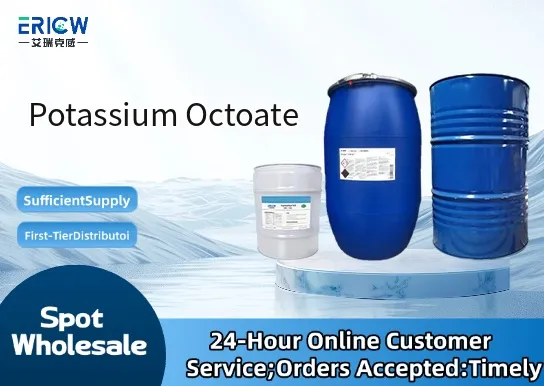
Highly effective catalyst for polyurethane foam formation, especially flexible slabstock and molded foams.
Excellent solubility in polyols and compatibility with common formulation components.
Low volatility and minimal odor profile, supporting safer handling and improved workplace air quality.
Thermally stable under standard processing conditions (up to 120 °C), ensuring consistent catalytic activity during foaming.
Non-corrosive to stainless steel and aluminum equipment, reducing maintenance and extending reactor life.
Flexible polyurethane foam production (slabstock, molded, and integral skin foams).
Catalyst component in water-blown urethane systems for automotive seating and bedding.
Co-catalyst with tertiary amines (e.g., DABCO® 33-LV) to balance gelling and blowing kinetics.
Formulation additive in flame-retardant PU foams where metal-based catalysts are preferred over volatile amines.
Intermediate in specialty polymer synthesis requiring potassium-mediated transesterification or condensation reactions.
| Chemical Type | Potassium salt of 2-ethylhexanoic acid (octoic acid) |
| Product Form | Clear to pale yellow liquid |
| Appearance | Homogeneous, free-flowing liquid at 25 °C |
| Melting Point | Approx. –15 °C (liquid at room temperature) |
| Primary Applications | Polyurethane foam catalysis (gelling reaction) |
| Key Features | Strong basic character; selective promotion of urethane (OH–NCO) bond formation |
| Benefits | Improved foam cell structure, reduced shrinkage, enhanced dimensional stability |
| Regulatory Compliance | REACH registered; compliant with EU Directive 2009/48/EC (toys) for migration limits (as formulated) |
| Common Compatible Systems | Suitability |
| Polyether polyols (e.g., Voranol™, Arcol™ series) | Highly Recommended – Fully miscible; no phase separation observed |
| Polystyrene-polyisocyanurate (PS-PIR) hybrid foams | Recommended – Effective co-catalyst with delayed reactivity profile |
| Water-blown flexible PU systems | Highly Recommended – Enables low-emission formulations without amine odor |
| Biobased polyols (e.g., soy-, castor oil-derived) | Suitable – May require minor dosage adjustment due to variable OH functionality |
Q1: What is the CAS Number for Potassium Octoate?
A: The CAS Registry Number for Potassium Octoate is 1702-32-3.
Q2: What is the typical usage level in flexible PU foam formulations?
A: Standard dosage ranges from 0.05 to 0.3 phr (parts per hundred polyol), depending on desired gel time, foam density, and co-catalyst selection.
Q3: How does Potassium Octoate compare to Dibutyltin Dilaurate (DBTDL) in terms of performance and regulatory status?
A: Potassium Octoate provides comparable gelling activity without tin-based toxicity concerns; it is not classified as CMR (Carcinogenic, Mutagenic, Reprotoxic) and avoids REACH Annex XIV sunset provisions applicable to organotins.
Q4: Is Potassium Octoate subject to migration or extraction in end-use applications such as furniture foam or automotive interiors?
A: When fully reacted into the polymer matrix, potassium octoate residues are chemically bound and exhibit negligible migration; extractable levels in standardized tests (e.g., EN 14372, ISO 10993-12) remain well below regulatory thresholds for consumer products.
Contact With Us:
E-mail: wangxingqiang@ericwchem.com
Have a Questions? Call Us:
Add:
Building A1, Jiete Industrial Park, Huangpu District, Guangzhou City, Guangdong Province, China