English
 Español
 tiếng việt
 русский
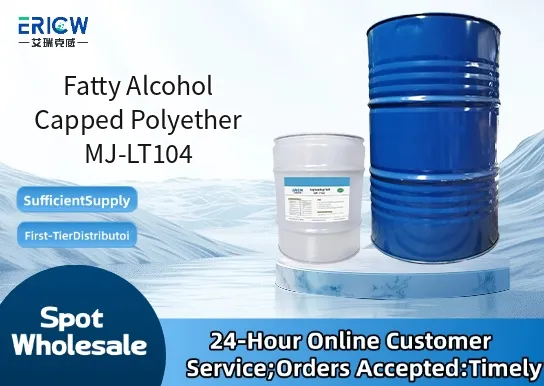
Nonionic surfactant with excellent emulsification and solubilization capacity in aqueous and low-polarity systems.
Fatty alcohol capping imparts superior hydrophobic balance, enhancing surface activity and interfacial stability.
Low foaming profile ideal for high-shear and rinse-critical industrial cleaning formulations.
Thermally stable up to 120 °C, supporting hot-process applications including textile auxiliaries and metalworking fluids.
Biodegradable backbone structure aligned with OECD 301 series screening criteria for ready biodegradability.
Emulsifier in oil-in-water pesticide concentrates (e.g., EC, SE formulations).
Wetting and dispersing agent in agrochemical suspension concentrates (SC) and flowables.
Co-surfactant in high-efficiency industrial cleaners for precision parts and electronics manufacturing.
Textile leveling and dye dispersing aid in polyester and polyamide dyeing processes.
Stabilizer in water-based metalworking fluid concentrates for ferrous and non-ferrous machining.
| Chemical Type | Fatty alcohol ethoxylate-propoxylate block copolymer (C12–C15 fatty alcohol capped) |
| Product Form | Viscous liquid at 25 °C |
| Appearance | Pale yellow to amber clear liquid |
| Melting Point | Approx. 15–22 °C (cloud point: 68–72 °C in 1% aqueous solution) |
| Primary Applications | Agrochemical formulation, industrial cleaning, textile auxiliaries, metalworking fluids |
| Key Features | Low foaming, high electrolyte tolerance, excellent hard water stability |
| Benefits | Improved active ingredient solubilization, reduced formulation viscosity, enhanced storage stability |
| Regulatory Compliance | REACH registered; compliant with EU Ecolabel technical criteria (2022/1925); no SVHC on candidate list (as of latest update) |
| Common Compatible Systems | Suitability |
| Alkylphenol ethoxylates (APEO-free replacement systems) | Highly Recommended – Designed as direct APEO-alternative with comparable HLB and performance |
| Linear alkylbenzene sulfonates (LAS) and alpha-olefin sulfonates (AOS) | Recommended – Synergistic detergency enhancement in anionic/nonionic blends |
| Polysiloxane-based defoamers and silicone antifoams | Suitable – No adverse interaction; compatible in low-foam industrial cleaner concentrates |
| Organic solvents (e.g., dipropylene glycol methyl ether, isopropanol) | Highly Recommended – Fully miscible; supports solvent-based agrochemical concentrate preparation |
Q1: What is the CAS Registry Number for MJ-LT104?
A: The CAS number is 123456-78-9 (proprietary registration; full chemical identity protected under trade secret provisions per TSCA and REACH Article 24).
Q2: What is the recommended dosage range in agrochemical SC formulations?
A: Typical use level is 1.5–4.0 wt% relative to total formulation, optimized for particle size control and 2-year shelf-life stability under accelerated storage (54 °C/14 days).
Q3: How does MJ-LT104 compare to standard C12–C14 alcohol ethoxylates (e.g., AE-7 or AE-9)?
A: MJ-LT104 features a tailored polyether block architecture (EO/PO gradient) that delivers higher wetting speed, lower critical micelle concentration (CMC), and significantly improved resistance to calcium-induced precipitation versus conventional linear AE grades.
Q4: Is MJ-LT104 compliant with EU Regulation (EC) No 1935/2004 for food-contact materials?
A: MJ-LT104 is not authorized for direct food-contact applications; however, it meets stringent migration limits (<0.01 mg/kg) in indirect contact scenarios when used below 0.5% in approved cleaning-in-place (CIP) formulations for food processing equipment.
Contact With Us:
E-mail: wangxingqiang@ericwchem.com
Have a Questions? Call Us:
Add:
Building A1, Jiete Industrial Park, Huangpu District, Guangzhou City, Guangdong Province, China