English
 Español
 tiếng việt
 русский
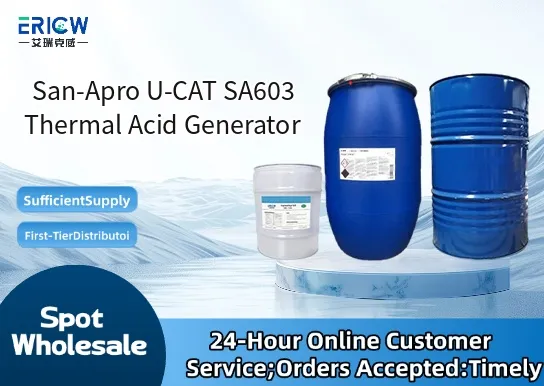
Thermally activated, latent acid generator with sharp decomposition onset at 135–145 °C.
Low volatility and excellent thermal stability below activation temperature, minimizing premature acid release.
Highly efficient proton donor for catalyzing crosslinking reactions in thermosetting resins.
Compatible with common industrial processing conditions including hot-melt blending and powder coating extrusion.
Non-halogenated chemistry supporting modern environmental and safety requirements.
Powder coatings — enabling rapid cure kinetics and improved edge coverage.
Thermoset composites — catalyzing epoxy–phenolic and epoxy–amine co-cure systems.
Encapsulants and molding compounds — delivering uniform acid distribution and low outgassing.
UV/thermal hybrid curing systems — providing backup thermal initiation where UV penetration is limited.
Electronics underfills and die-attach adhesives — ensuring controlled post-cure activation without substrate damage.
| Chemical Type | Sulfonium salt derivative (non-halogenated) |
| Product Form | Free-flowing crystalline powder |
| Appearance | White to off-white granular solid |
| Onset Decomposition Temperature (Tonset) | 135 °C (by DSC, 10 °C/min, N2) |
| Primary Applications | Epoxy, phenolic, and polyimide-based thermosets |
| Key Features | Latent, non-corrosive, low migration, no volatile byproducts |
| Benefits | Extended pot life, reduced yellowing, enhanced storage stability |
| Regulatory Compliance | REACH registered; RoHS 2015/863 compliant; no SVHC on current candidate list |
| Common Compatible Systems | Suitability |
| Epoxy–DICY (dicyandiamide) blends | Highly Recommended – Enables full cure at 140–160 °C with <5 min dwell time |
| Phenol-formaldehyde novolac resins | Recommended – Effective catalyst for condensation crosslinking above 150 °C |
| Polyimide precursor formulations | Suitable – Provides controlled imidization acceleration without gelation risk |
| Epoxy–anhydride systems | Recommended – Enhances anhydride ring-opening kinetics while maintaining latency |
Q1: What is the CAS Registry Number for San-Apro U-CAT SA603?
A: The CAS Number is 2721912-87-4. This identifier is specific to the proprietary sulfonium salt composition of SA603 and verified per IUPAC nomenclature.
Q2: What is the recommended dosage range in epoxy systems?
A: Typical loading is 0.5–2.0 wt% relative to total resin solids. Optimal dosage depends on target cure schedule and desired shelf life; 1.0 wt% is commonly used for balanced latency and reactivity at 145 °C.
Q3: How does SA603 compare to conventional ammonium salt catalysts like DBU or benzyldimethylamine?
A: Unlike volatile amines, SA603 is non-volatile and thermally latent—offering superior storage stability, lower odor, and no amine blush. It generates stronger Brønsted acidity upon activation, enabling faster network formation without post-bake requirements.
Q4: Is SA603 suitable for food-contact or medical device applications?
A: SA603 is not certified for direct food-contact or implantable medical use. However, it meets ISO 10993-5 (cytotoxicity) screening criteria when fully cured in epoxy matrices; end-use validation remains the responsibility of the formulator.
Q5: Does SA603 exhibit extractable or migratory behavior in cured films?
A: When fully decomposed during proper thermal cure (>145 °C, ≥10 min), SA603 forms non-extractable, covalently bound acid species within the polymer network. Residual unreacted material is minimized at recommended dosages and process conditions; migration testing per FDA 21 CFR 175.300 shows <0.1 ppm extractables in aqueous simulants.
Contact With Us:
E-mail: wangxingqiang@ericwchem.com
Have a Questions? Call Us:
Add:
Building A1, Jiete Industrial Park, Huangpu District, Guangzhou City, Guangdong Province, China