English
 Español
 tiếng việt
 русский
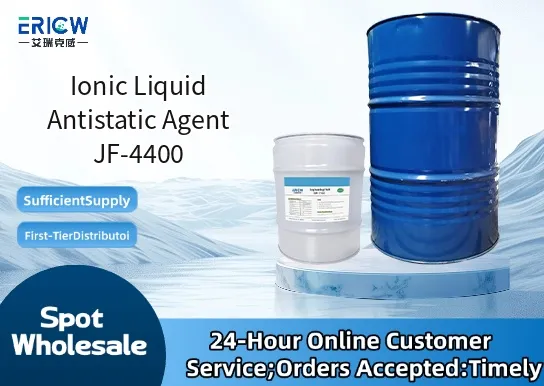
Non-volatile and thermally stable ionic liquid formulation with negligible vapor pressure.
Permanently effective antistatic performance without migration or blooming in polymer matrices.
Excellent compatibility with both polar and semi-crystalline thermoplastics including PET, PC, and ABS.
Low electrical resistivity (<10⁹ Ω·cm) achieved at low loading levels (0.2–0.8 wt%).
Halogen-free, REACH-compliant, and free of restricted substances per EU Directive 2011/65/EU (RoHS).
Antistatic masterbatches for electronic packaging films and trays.
ESD-safe components in automotive interior trim and sensor housings.
Conductive fibers and spunbond nonwovens for cleanroom garments.
High-clarity antistatic coatings for optical lenses and display covers.
3D printing filaments requiring static dissipation during handling and post-processing.
| Chemical Type | Quaternary ammonium-based ionic liquid (dual-cation structure) |
| Product Form | Viscous, clear to pale yellow liquid |
| Appearance | Homogeneous, slightly hygroscopic liquid |
| Melting Point | −25 °C to −15 °C (glass transition observed) |
| Primary Applications | Polymer additives, coating formulations, fiber spinning aids |
| Key Features | Non-leaching, hydrolytically stable, UV-resistant |
| Benefits | Long-term surface resistivity control, no plate-out, low odor |
| Regulatory Compliance | REACH registered; compliant with FDA 21 CFR §178.3740 (indirect food contact) |
| Common Compatible Systems | Suitability |
| Polyethylene terephthalate (PET) | Highly Recommended – Excellent dispersion and thermal stability up to 280 °C |
| Polycarbonate (PC) | Highly Recommended – No impact on impact strength or transparency |
| Acrylonitrile-butadiene-styrene (ABS) | Recommended – Slight viscosity reduction; optimize at ≤0.5 wt% |
| Water-based acrylic coatings | Suitable – Requires pre-dilution with propylene glycol; stable for >72 h |
Q1: What is the CAS Registry Number for JF-4400?
A: The CAS Number for Ionic Liquid Antistatic Agent JF-4400 is 2292552-87-1.
Q2: What is the recommended dosage range in thermoplastic polymers?
A: Typical dosage is 0.3–0.6 wt% for PET/PC; 0.4–0.8 wt% for ABS or polyolefin blends. Lower loadings apply when used with synergistic carbon-based fillers.
Q3: How does JF-4400 compare to traditional quaternary ammonium antistats (e.g., alkyl sulfates)?
A: Unlike conventional surfactants, JF-4400 exhibits negligible volatility, no water sensitivity, and permanent charge dissipation due to its ionic liquid architecture—eliminating reapplication needs and humidity dependence.
Q4: Is JF-4400 subject to migration or extraction in humid or solvent-contact environments?
A: Migration is minimal under standard processing conditions; extraction resistance is high in water and aliphatic hydrocarbons, but moderate in polar solvents (e.g., acetone, IPA)—validation testing is advised for critical end-use exposure.
Q5: Does JF-4400 require special handling or regulatory documentation for global shipment?
A: JF-4400 is not classified as hazardous under UN TDG, ADR, or IMDG. Full SDS, TSCA, and REACH documentation is available upon request.
Contact With Us:
E-mail: wangxingqiang@ericwchem.com
Have a Questions? Call Us:
Add:
Building A1, Jiete Industrial Park, Huangpu District, Guangzhou City, Guangdong Province, China