English
 Español
 tiếng việt
 русский
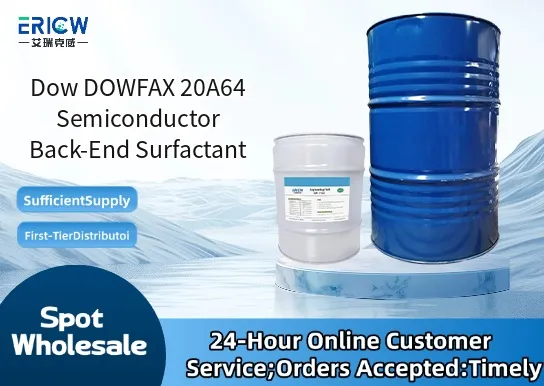
Ultra-low residue formulation engineered specifically for semiconductor back-end cleaning and rinse processes.
Exceptional wetting and surface tension reduction in deionized water at low concentrations (0.01–0.1 wt%).
Nonionic, alcohol ether sulfate-based chemistry with high hydrolytic stability under neutral-to-mildly alkaline conditions.
Low metal ion content (Na⁺, K⁺, Ca²⁺ < 1 ppm) and ultra-low particle generation—meets SEMI F57 purity standards.
Compatible with advanced packaging materials including copper, low-k dielectrics, and polymer-based redistribution layers (RDL).
Post-CMP (Chemical Mechanical Planarization) rinse for copper and barrier metal removal.
Wafer-level cleaning prior to underfill or molding compound application.
Rinse aid in flip-chip bump cleaning and solder flux residue mitigation.
Surface conditioning step before wafer bonding or thin-film encapsulation.
Residue control additive in aqueous-based dicing tape removal solutions.
| Chemical Type | Alcohol ether sulfate (AES), nonionic/anionic hybrid surfactant |
| Product Form | Aqueous solution (~30 wt% active) |
| Appearance | Clear, colorless to pale yellow liquid |
| pH (1% aqueous solution, 25°C) | 6.5–7.5 |
| Primary Applications | Semiconductor back-end cleaning, rinse enhancement, residue minimization |
| Key Features | Low foaming, ultra-low ionic impurities, high rinse efficiency |
| Benefits | Reduces pattern collapse, improves yield in fine-pitch packaging, enables lower DIW consumption |
| Regulatory Compliance | REACH registered; RoHS compliant; no SVHCs above threshold per current Annex XIV |
| Common Compatible Systems | Suitability |
| Deionized Water (DIW) rinse systems | Highly Recommended – Designed for direct integration into standard DIW-based rinse modules |
| SEMI-standard single-wafer spin-rinse dryers (SRDs) | Highly Recommended – Validated for uniform film removal without re-deposition |
| Low-temperature aqueous cleaning chemistries (pH 5–8) | Recommended – Stable when co-formulated with mild chelators and organic solubilizers |
| Post-plating rinse baths for Cu/ NiP UBM layers | Suitable – Demonstrated compatibility with electroplated metallization integrity |
Q1: What is the CAS Registry Number for DOWFAX 20A64?
A: The CAS Registry Number is 68439-49-6 (representative for the primary AES component; full product is a proprietary aqueous formulation).
Q2: What is the recommended dosage range in semiconductor rinse applications?
A: Typical use level is 0.02–0.08 wt% in deionized water; optimal concentration is process- and tool-specific and should be validated via particle count and contact angle testing.
Q3: How does DOWFAX 20A64 differ from conventional DOWFAX C6L or DOWFAX 8390 in semiconductor use?
A: Unlike general-purpose DOWFAX grades, 20A64 is purified to semiconductor-grade limits (sub-ppm metals, <0.1 µm particles), features tailored HLB (~12.5), and is formulated without solvents or hydrotropes that risk extractables or outgassing in vacuum environments.
Q4: Is DOWFAX 20A64 compliant with JEDEC J-STD-033 moisture sensitivity requirements for post-process handling?
A: Yes — residual surfactant film is non-hygroscopic and thermally stable up to 125°C; validated for MSL 1–3 packaging flows with no impact on floor life or reflow reliability.
Q5: Has migration or leaching of DOWFAX 20A64 been observed into adjacent dielectric layers during thermal cycling?
A: No migration has been detected per TOF-SIMS and FTIR analysis after 1000 cycles (−40°C to +125°C); the molecule’s polarity and size limit diffusion into low-k SiCOH or polyimide matrices.
Contact With Us:
E-mail: wangxingqiang@ericwchem.com
Have a Questions? Call Us:
Add:
Building A1, Jiete Industrial Park, Huangpu District, Guangzhou City, Guangdong Province, China