English
 Español
 tiếng việt
 русский
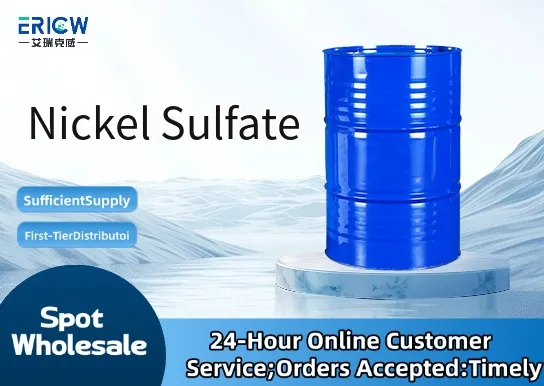
High-purity crystalline solid with excellent solubility in water for consistent process performance.
Stable under standard storage conditions—resists deliquescence and decomposition when kept dry.
Consistent stoichiometry (NiSO₄·6H₂O) ensures predictable nickel ion release in electroplating and catalysis.
Low chloride and heavy metal impurities meet stringent requirements for electronics-grade plating baths.
Manufactured under ISO 9001-certified quality control with full traceability and batch-specific CoA.
Primary nickel source in Watts-type and sulfamate-based electroplating electrolytes for corrosion-resistant metallic coatings.
Catalyst precursor in hydrogenation, reforming, and polymerization processes within petrochemical and fine chemical synthesis.
Nutrient additive in controlled-environment agriculture (CEA) and hydroponic nutrient solutions for nickel-dependent urease activation.
Raw material in the production of nickel oxide, nickel carbonate, and advanced cathode precursors for lithium-ion batteries.
Electrolyte component in nickel–metal hydride (NiMH) battery manufacturing and electrodeposition of functional alloys (e.g., Ni–Fe, Ni–Co).
| Chemical Type | Hydrated inorganic salt (Nickel(II) sulfate hexahydrate) |
| Product Form | Free-flowing green crystalline granules or powder |
| Appearance | Emerald-green, translucent crystals; no visible clumping or discoloration |
| Molecular Formula | NiSO₄·6H₂O |
| Nickel (Ni) Content (w/w, min.) | 22.3% (calculated, anhydrous basis: 64.7% NiSO₄) |
| pH (5% aqueous solution) | 3.5 – 4.5 |
| Solubility in Water (20°C) | 64 g/100 mL |
| Regulatory Compliance | REACH registered; SDS available; non-RCRA hazardous per US EPA (40 CFR 261); not classified as PBT/vPvB |
| Common Compatible Systems | Suitability |
| Watts Nickel Plating Baths (with NiCl₂ and H₃BO₃) | Highly Recommended – Primary nickel source; enables uniform deposition and high throwing power |
| Sulfamate Nickel Electrolytes | Highly Recommended – Low-stress deposits; compatible with boric acid and wetting agents |
| Aqueous Hydroponic Nutrient Blends (Ca/Mg/K-based) | Recommended – Stable in pH 5.5–6.5 chelated formulations; avoid direct mixing with phosphates |
| NiMH Battery Electrode Slurry Systems (PVDF/NMP) | Suitable – Requires pre-dissolution and pH-controlled dispersion; not directly dispersible in organic solvents |
Q1: What is the CAS Registry Number for nickel sulfate hexahydrate?
A: The CAS number is 10101-97-0 for nickel(II) sulfate hexahydrate (NiSO₄·6H₂O).
Q2: How does nickel sulfate compare to nickel chloride in electroplating baths?
A: Nickel sulfate provides the bulk nickel ions with high current efficiency and low internal stress; nickel chloride acts primarily as a conductivity enhancer and anode activator. They are complementary—not interchangeable—due to differing anion effects on bath stability and deposit properties.
Q3: Is nickel sulfate subject to EU Nickel Directive (2004/96/EC) restrictions for consumer products?
A: The EU Nickel Directive restricts nickel release from post-assembled products in prolonged skin contact (e.g., jewelry, zippers). Nickel sulfate itself is not restricted in industrial use, but finished articles must comply with ≤0.5 µg/cm²/week migration limits—verified via EN 1811 testing.
Q4: Can nickel sulfate be used in food-contact applications?
A: No—nickel sulfate is not approved for direct food-contact use under FDA 21 CFR or EU Regulation (EC) No. 1935/2004. It is strictly for industrial, agricultural, or research applications where final product exposure is fully controlled and validated.
Contact With Us:
E-mail: wangxingqiang@ericwchem.com
Have a Questions? Call Us:
Add:
Building A1, Jiete Industrial Park, Huangpu District, Guangzhou City, Guangdong Province, China