English
 Español
 tiếng việt
 русский
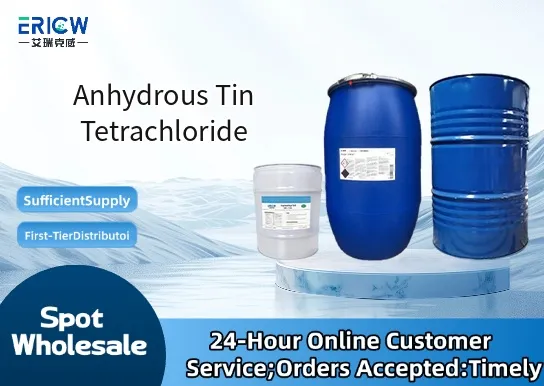
High-purity anhydrous formulation (>99.9% assay) ensures minimal water interference in moisture-sensitive reactions.
Strong Lewis acidity enables efficient catalysis in Friedel–Crafts acylations and esterifications.
Low boiling point (114 °C) facilitates easy removal post-reaction via distillation under mild conditions.
Non-oxidizing nature preserves sensitive functional groups during metal-mediated syntheses.
Consistent batch-to-batch performance certified with full traceability and CoA documentation.
Catalyst for the synthesis of organotin compounds, including vinyltin and allyltin reagents used in Stille coupling.
Reagent in the preparation of tin oxide (SnO₂) thin films via chemical vapor deposition (CVD) for transparent conductive coatings.
Dehydrating agent in the production of high-molecular-weight polyesters and polycarbonates.
Intermediate in the manufacture of flame-retardant additives and PVC stabilizers.
Etchant and dopant precursor in semiconductor fabrication processes requiring precise tin incorporation.
| Chemical Type | Inorganic tin(IV) halide |
| Product Form | Liquid (clear, colorless to pale yellow) |
| Appearance | Clear, fuming liquid with pungent odor |
| Melting Point | −33 °C |
| Boiling Point | 114 °C at 760 mmHg |
| Density (20 °C) | 2.226 g/cm³ |
| Assay (by titration) | ≥99.9% SnCl₄ |
| Water Content (KF) | ≤50 ppm |
| Common Compatible Systems | Suitability |
| Anhydrous chlorinated solvents (e.g., CH₂Cl₂, CCl₄) | Highly Recommended – Stable, non-reactive dissolution medium for catalytic use |
| Organic acid anhydrides (e.g., acetic anhydride) | Recommended – Compatible as co-reagent in acylation systems |
| Alkyl/aryl chlorides (e.g., benzyl chloride) | Suitable – Reacts controllably under stoichiometric conditions |
| Stainless steel (316 SS) and glass-lined reactors | Highly Recommended – Corrosion-resistant handling at ambient temperatures |
Q1: What is the CAS Number for Anhydrous Tin Tetrachloride?
A: The CAS Registry Number is 7646-78-8.
Q2: How should Anhydrous Tin Tetrachloride be handled to prevent hydrolysis during storage or transfer?
A: Store under inert atmosphere (N₂ or Ar) in sealed, moisture-proof containers; use dry-gas purged syringes or cannula techniques for transfer; avoid exposure to ambient humidity above 30% RH.
Q3: How does Anhydrous Tin Tetrachloride compare to Titanium Tetrachloride (TiCl₄) as a Lewis acid catalyst?
A: SnCl₄ exhibits milder Lewis acidity than TiCl₄, offering better functional group tolerance and reduced risk of substrate decomposition; it also demonstrates superior selectivity in asymmetric aldol-type reactions when paired with chiral ligands.
Q4: Is Anhydrous Tin Tetrachloride compliant with REACH and RoHS regulations?
A: Yes — supplied with full REACH registration (EU No. 01-2119458032-42-XXXX) and RoHS-compliant documentation; contains no SVHC substances above threshold levels per current Annex XIV.
Contact With Us:
E-mail: wangxingqiang@ericwchem.com
Have a Questions? Call Us:
Add:
Building A1, Jiete Industrial Park, Huangpu District, Guangzhou City, Guangdong Province, China