English
 Español
 tiếng việt
 русский
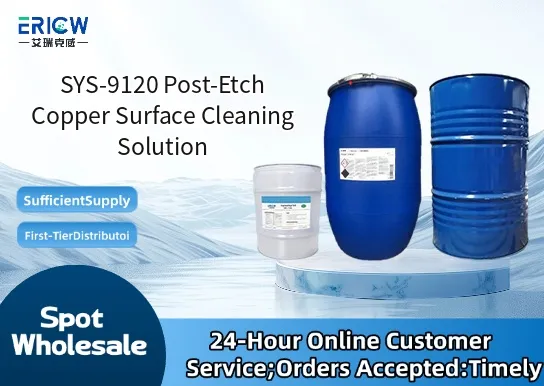
Highly selective removal of post-etch copper residues without attacking underlying copper traces or dielectric layers.
Low foaming formulation optimized for high-speed, inline spray and immersion cleaning systems.
Non-corrosive to stainless steel, nickel alloys, and common semiconductor tool materials.
Water-rinseable with minimal drag-out, supporting low DI water consumption and reduced waste treatment load.
Stable performance across a broad temperature range (20–50 °C) and compatible with standard process monitoring controls.
Copper interconnect cleaning after chloride-based dry etch in advanced logic and memory device fabrication.
Post-etch residue removal in Cu/Low-k BEOL (Back-End-of-Line) processes.
Cleaning of copper seed layers prior to barrier deposition or electroplating rework steps.
Residue management in 3D IC and fan-out wafer-level packaging (FOWLP) manufacturing lines.
Surface preparation for copper-to-copper hybrid bonding applications requiring ultra-low organic and halide contamination.
| Chemical Type | Aqueous chelating complex with organic acid buffers and surfactant stabilizers |
| Product Form | Liquid concentrate (ready-to-dilute) |
| Appearance | Clear, pale yellow to amber liquid |
| pH (1% aqueous solution, 25 °C) | 4.2 – 4.8 |
| Density (25 °C) | 1.06 – 1.09 g/cm³ |
| Primary Applications | Post-dry-etch copper surface cleaning in semiconductor front-end and back-end processes |
| Key Features | Halide-free, low-metal-ion content, non-oxidizing, no peroxide or strong oxidants |
| Regulatory Compliance | REACH compliant; RoHS 2 Directive (2011/65/EU) conformant; SDS available upon request |
| Common Compatible Systems | Suitability |
| SEZ™ (now SCREEN) Dainippon Screen SSW series | Highly Recommended – Validated for spray rinse and megasonic modules at 30–45 °C |
| TOKYO ELECTRON (TEL) CLEAN TRACK™ series | Highly Recommended – Fully integrated with ACT, ACT8, and LITHIUS platforms |
| Applied Materials (AMAT) MIRRA® and REFLEXION® platforms | Recommended – Requires minor pump seal compatibility verification (EPDM/Viton® confirmed) |
| Custom-built inline wet benches with PVC/PP construction | Suitable – Compatible with standard polypropylene, PVDF, and fluoropolymer fluidic components |
Q1: What is the CAS Registry Number for SYS-9120?
A: SYS-9120 is a proprietary multi-component formulation; individual ingredients are disclosed under confidentiality, and the mixture itself does not carry a single CAS number. Full ingredient disclosure is provided in the Safety Data Sheet (SDS) per regulatory requirements.
Q2: What is the recommended working concentration and dwell time?
A: Typical use concentration is 3–8% v/v in deionized water. Dwell time ranges from 30–120 seconds depending on etch severity and equipment configuration; optimization via Q-time testing is advised for new process integration.
Q3: How does SYS-9120 differ from traditional citric- or glycine-based cleaners?
A: SYS-9120 employs a synergistic chelator system with enhanced selectivity for copper chlorides and oxides, offering faster residue clearance, lower temperature operation, and significantly reduced risk of copper redeposition compared to conventional formulations.
Q4: Does SYS-9120 meet SEMI S2/S8 safety and environmental standards?
A: Yes — SYS-9120 has been assessed per SEMI S2-17A and S8-17A guidelines. It carries a low hazard profile (GHS Category 4 skin irritation, no acute toxicity or environmental hazards), and full compliance documentation is available to qualified customers.
Q5: Is there any risk of extractables or leachables when used with PTFE or FFKM seals?
A: No significant extractables have been observed in qualification testing with PTFE, FFKM (e.g., Kalrez®), or EPDM seals under standard operating conditions. Extractables profiling per USP <87>/<88> and ICH Q5C is available upon request.
Contact With Us:
E-mail: wangxingqiang@ericwchem.com
Have a Questions? Call Us:
Add:
Building A1, Jiete Industrial Park, Huangpu District, Guangzhou City, Guangdong Province, China