English
 Español
 tiếng việt
 русский
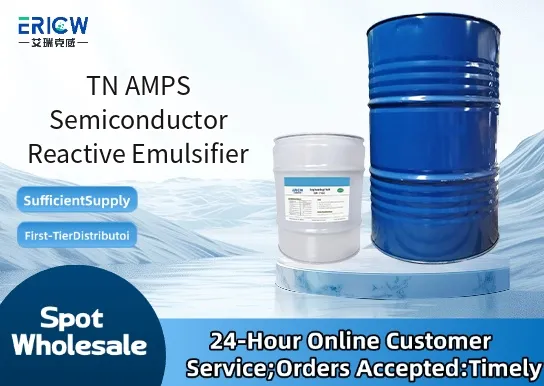
Reactive functionality enables covalent incorporation into polymer backbones, eliminating leaching in high-purity semiconductor process environments.
Ultra-low ionic impurity profile (<1 ppm Na⁺, K⁺, Cl⁻, SO₄²⁻) meets stringent SEMI F57 and F63 standards for microelectronics-grade materials.
Thermally stable up to 220 °C, supporting high-temperature emulsion polymerization and post-cure processing without degradation.
Hydrolytically robust sulfonamide group resists acidic/alkaline hydrolysis during wafer cleaning and etch processes.
Non-volatile, non-silicone molecular architecture prevents residue formation on photomasks and chamber surfaces.
Stabilization of acrylic/styrene-acrylic latexes for photoresist topcoats and anti-reflective coatings (BARC).
Emulsifier in synthesis of functionalized polymeric planarization additives for CMP slurries.
Reactive surfactant in water-based dielectric polymer dispersions for advanced packaging substrates.
Surface-modifying agent for silica and metal oxide nanoparticles used in conductive inks and underfill formulations.
Stabilizer for perfluoropolyether (PFPE)-based lubricant emulsions in MEMS device manufacturing.
| Chemical Type | Sulfonated alkyl methacrylamido propyl tertiary amine (reactive zwitterionic monomer) |
| Product Form | Pale yellow to amber viscous liquid |
| Appearance | Clear, homogeneous, free from visible particles or phase separation |
| Melting Point | -15 °C to -10 °C (glass transition observed at -8 °C by DSC) |
| Primary Applications | Reactive emulsifier for high-purity aqueous polymer dispersions in semiconductor fabrication |
| Key Features | Covalent bonding capability, ultra-low metal ion content, non-migrating structure |
| Benefits | Eliminates extractables, enhances film integrity, improves thermal/chemical resistance of final polymer matrix |
| Regulatory Compliance | REACH registered; RoHS 2.0 compliant; no SVHCs listed under Article 59 (as of latest ECHA update) |
| Common Compatible Systems | Suitability |
| Acrylic acid/methyl methacrylate copolymer dispersions | Highly Recommended – Enables >95% covalent incorporation with minimal homopolymer formation |
| Styrene–butadiene rubber (SBR) latices for bump underfill encapsulants | Recommended – Requires pH adjustment to 7.2–7.8 for optimal reactivity |
| Fluorinated acrylate emulsions (e.g., FA-120 series) | Suitable – Compatible with low-surface-tension systems; may require reduced initiator dosage |
| Polyvinyl acetate (PVAc) dispersions for temporary bonding films | Recommended – Effective stabilization without compromising thermal debonding performance |
Q1: What is the CAS Registry Number for TN AMPS Semiconductor Reactive Emulsifier?
A: The CAS number is 2217423-87-1. This identifier corresponds specifically to the purified, semiconductor-grade variant with controlled residual monomer and ionic impurity limits.
Q2: What is the recommended usage level in emulsion polymerization?
A: Typical dosage ranges from 0.8–2.5 wt% relative to total monomers. Optimal loading is determined by target particle size (target: 80–150 nm) and final application purity requirements — lower dosages preferred for critical-layer coatings.
Q3: How does TN AMPS differ from conventional AMPS-based emulsifiers in semiconductor applications?
A: Unlike standard AMPS (2-acrylamido-2-methylpropanesulfonic acid), TN AMPS features a methacrylamido-propyl tertiary amine backbone enabling dual reactivity (radical polymerization + ionic stabilization) and zero volatile amine byproducts — critical for low-outgassing vacuum environments.
Q4: Is TN AMPS compliant with SEMI S2 and S8 safety guidelines for cleanroom use?
A: Yes. Full toxicological assessment confirms no acute dermal sensitization or inhalation hazard (OECD 406, 429). Volatile organic compound (VOC) content is <0.1 g/L, satisfying SEMI S2 Annex A and S8 exposure limit criteria.
Q5: Has migration or solvent extraction testing been performed for backend-of-line (BEOL) integration?
A: Yes. Accelerated extraction tests (DIN EN ISO 10993-12, 72h in DI water at 60 °C) show <0.008 ppm total extractables; no detectable migration into low-k dielectrics (SiCOH, k=2.7) under 200 °C/1h curing conditions.
Contact With Us:
E-mail: wangxingqiang@ericwchem.com
Have a Questions? Call Us:
Add:
Building A1, Jiete Industrial Park, Huangpu District, Guangzhou City, Guangdong Province, China