English
 Español
 tiếng việt
 русский
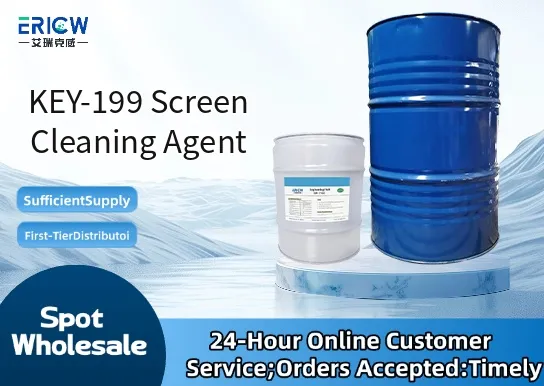
Non-corrosive formulation specifically engineered for delicate optical and electronic display surfaces.
Volatile organic compound (VOC)-compliant solvent blend with rapid evaporation and zero residue.
Static-dissipative properties minimize particulate attraction during and after cleaning.
Halogen-free and non-ozone-depleting, aligned with global environmental stewardship standards.
Compatible with common screen protection coatings including oleophobic and anti-reflective layers.
Cleaning of TFT-LCD, OLED, and microLED display panels in semiconductor and flat-panel display manufacturing.
Maintenance of touchscreens in industrial HMIs, medical diagnostic monitors, and aviation cockpit displays.
Pre-bonding surface preparation for optical adhesives and laminated display assemblies.
Final wipe-down of precision optical components in AR/VR headset production lines.
Re-work and repair cleaning of high-resolution inspection equipment screens (e.g., AOI, SPI systems).
| Chemical Type | Proprietary azeotropic solvent blend (halogen-free) |
| Product Form | Liquid (ready-to-use) |
| Appearance | Clear, colorless liquid |
| Odor | Faint, neutral solvent odor |
| Primary Applications | Optical display cleaning, precision electronics surface decontamination |
| Key Features | Non-corrosive, static-dissipative, low surface tension, fast-drying |
| Benefits | No streaking, no coating degradation, safe for PET, ITO, and AR films |
| Regulatory Compliance | REACH compliant; RoHS 2.0 compatible; no SVHCs above threshold |
| Common Compatible Systems | Suitability |
| Automated spray-clean systems (e.g., GEMETEC, MRC) | Highly Recommended – Optimized for nozzle compatibility and uniform mist dispersion |
| Manual lint-free wipe protocols (e.g., Texwipe TX4215, Berkshire AlphaWipe) | Highly Recommended – No fiber shedding or chemical interaction |
| Ultrasonic cleaning baths (40–60 kHz, ambient temperature) | Recommended – Effective for pre-cleaning frame assemblies; avoid prolonged immersion |
| In-line vapor degreasing equipment (low-boiling point configuration) | Suitable – Requires condenser temperature adjustment; consult technical bulletin |
Q1: What is the CAS Registry Number for KEY-199 Screen Cleaning Agent?
A: KEY-199 is a proprietary multi-component formulation and does not have a single CAS number; individual constituents are listed under CAS numbers 108-88-3 (p-xylene), 110-54-3 (n-butyl acetate), and 78-93-3 (ethyl acetate) — full composition disclosed under NDA.
Q2: What is the recommended application method and typical usage rate per square meter?
A: Apply via precision spray nozzle or saturated lint-free wipe; average consumption is 8–12 mL/m² for single-pass cleaning on standard display substrates.
Q3: How does KEY-199 differ from conventional IPA-based cleaners in terms of performance and safety?
A: Unlike IPA, KEY-199 offers lower surface tension for improved contaminant lift, reduced flammability (flash point >45°C), and no risk of ITO layer oxidation or polymer swelling.
Q4: Does KEY-199 meet ISO 14644-1 Class 5 cleanroom requirements for particle generation?
A: Yes — validated per ISO 14644-1 and JIS B 9920:2019; generates <1 particle ≥0.5 µm per 1000 L air when applied with certified wipes and controlled dispensing.
Q5: Has migration or extractables testing been performed for use in medical-grade display applications?
A: Yes — tested per USP <87> and <88> (cytotoxicity and systemic injection assays); no leachable organics detected by GC-MS after 72-hr extraction in simulated body fluid at 37°C.
Contact With Us:
E-mail: wangxingqiang@ericwchem.com
Have a Questions? Call Us:
Add:
Building A1, Jiete Industrial Park, Huangpu District, Guangzhou City, Guangdong Province, China