English
 Español
 tiếng việt
 русский
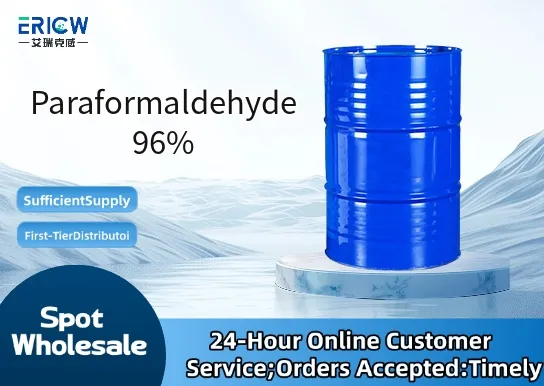
High-purity solid polymer of formaldehyde with ≥96% assay, ensuring consistent reactivity and minimal volatile formaldehyde emissions during handling.
Free-flowing, low-dust granular form optimized for accurate metering and safe industrial-scale processing.
Thermally stable below 120°C, enabling controlled depolymerization to formaldehyde vapor in thermal curing and resin synthesis applications.
Low residual water content (<0.5%), minimizing side reactions in moisture-sensitive condensation processes.
Manufactured under strict ISO 9001-certified quality control with batch traceability and full CoA documentation.
Synthesis of phenolic, urea-formaldehyde, and melamine-formaldehyde thermosetting resins for wood adhesives and foundry binders.
Crosslinking agent in textile finishing (e.g., crease-resistant cotton) and paper wet-strength resins.
Source of gaseous formaldehyde in electron microscopy tissue fixation protocols requiring precise, low-moisture delivery.
Chemical intermediate in agrochemical manufacturing, including synthesis of fungicides and plant growth regulators.
Formaldehyde donor in specialty coatings and encapsulation systems where liquid formaldehyde is impractical or hazardous.
| Chemical Type | Polyoxymethylene polymer (linear paraformaldehyde) |
| Product Form | White to off-white free-flowing granules |
| Appearance | Free of visible black specks or clumps |
| Melting/Decomposition Point | 120–170°C (gradual depolymerization) |
| Assay (as CH₂O) | ≥96.0% (by titration) |
| Residual Formaldehyde (monomer) | ≤0.3% (w/w, GC method) |
| Moisture Content | ≤0.5% (Karl Fischer) |
| Heavy Metals (as Pb) | ≤10 ppm |
| Common Compatible Systems | Suitability |
| Phenol-formaldehyde resin reactors | Highly Recommended – Excellent solubility in molten phenol; enables stoichiometric control and low free formaldehyde in final resin. |
| Thermal curing ovens (for textile finishing) | Highly Recommended – Predictable depolymerization kinetics at 140–160°C ensure uniform crosslinking without scorching. |
| Aqueous formaldehyde scavenger formulations | Recommended – Requires acid-catalyzed hydrolysis; effective when combined with controlled pH and temperature ramping. |
| Electron microscopy fixation kits | Highly Recommended – Preferred over formalin for ultra-low ionic strength and absence of methanol stabilizer. |
Q1: What is the CAS Number for Paraformaldehyde 96%?
A: The CAS Registry Number is 30525-89-4 (for polymeric paraformaldehyde); note that it is distinct from formalin (CAS 50-00-0) or trioxane (CAS 110-88-3).
Q2: How should Paraformaldehyde 96% be dosed relative to 37% aqueous formaldehyde?
A: Use a molar equivalence basis: 100 g of 96% paraformaldehyde provides ~125 g of pure formaldehyde (CH₂O), equivalent to ~340 g of 37% formalin solution. Always confirm stoichiometry via reaction mechanism and validate with pilot trials.
Q3: Does Paraformaldehyde 96% comply with REACH and meet food-contact safety requirements?
A: This grade is REACH-registered (ECHA dossier available). It is not approved for direct food-contact applications per FDA 21 CFR or EU 10/2011; however, it is widely used in indirect food-packaging resins (e.g., PF adhesives in plywood) where final extractables comply with migration limits.
Q4: Can Paraformaldehyde 96% be used as a replacement for formalin in biological fixation without altering protocol?
A: No — direct substitution is not advised. Paraformaldehyde requires alkaline hydrolysis (e.g., 0.1 M NaOH, gentle heating) or extended dissolution time (1–2 h at 60°C) to generate active formaldehyde. Standard formalin protocols assume immediate availability of monomeric CH₂O.
Contact With Us:
E-mail: wangxingqiang@ericwchem.com
Have a Questions? Call Us:
Add:
Building A1, Jiete Industrial Park, Huangpu District, Guangzhou City, Guangdong Province, China