English
 Español
 tiếng việt
 русский
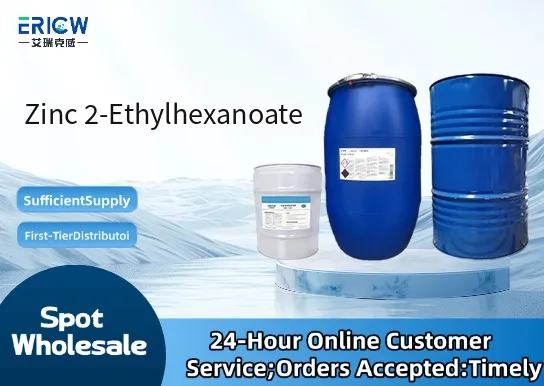
Highly soluble in organic solvents including hydrocarbons, esters, and ketones.
Acts as an efficient catalyst for polyurethane gelation and urea condensation reactions.
Offers excellent storage stability under ambient conditions with low volatility.
Provides superior metal ion dispersion due to its well-defined chelated structure.
Low odor profile compared to alternative carboxylate-based metal catalysts.
Catalyst in moisture-cured polyurethane sealants and adhesives.
Co-catalyst in one-component (1K) polyurethane coating systems.
Reaction accelerator in alkyd resin crosslinking and drying processes.
Performance enhancer in silicone-modified acrylic emulsion polymerization.
Stabilizing agent in UV-curable acrylate formulations requiring thermal latency.
| Chemical Type | Zinc carboxylate complex (chelated) |
| Product Form | Clear to pale yellow liquid |
| Appearance | Homogeneous, free-flowing liquid |
| Active Zinc Content (as Zn) | 9.5 – 10.5 wt% |
| Acid Value (mg KOH/g) | 45 – 55 |
| Solubility | Completely miscible with aromatic & aliphatic hydrocarbons, esters, and ketones |
| Primary Applications | Polyurethane catalysis, alkyd drying, hybrid resin crosslinking |
| Regulatory Compliance | REACH registered; not classified under CLP for acute toxicity or skin sensitization |
| Common Compatible Systems | Suitability |
| Aromatic solvent-based polyurethane prepolymers | Highly Recommended – Excellent solubility and catalytic synergy with tin-free systems |
| Alkyd resins (soybean oil modified) | Recommended – Enhances through-dry without surface wrinkling |
| Acrylic/melamine thermoset coatings | Suitable – Functions as latent crosslinker accelerator at elevated cure temperatures |
| Waterborne polyurethane dispersions (PUDs) | Suitable – Requires pre-emulsification; limited direct addition due to hydrolytic sensitivity |
Q1: What is the CAS Number for Zinc 2-Ethylhexanoate?
A: The CAS Registry Number is 27253-29-8.
Q2: What is the typical usage level in PU sealant formulations?
A: Standard dosage ranges from 0.05 to 0.3 phr (parts per hundred resin), depending on desired pot life and cure speed; always pair with kinetic profiling for optimal balance.
Q3: How does it compare to dibutyltin dilaurate (DBTDL) in terms of regulatory acceptance and performance?
A: Zinc 2-ethylhexanoate is REACH-compliant and non-reprotoxic, unlike DBTDL (classified as reproductive toxicant Cat. 1B). It offers slower, more controllable gelation but lower overall reactivity—ideal for tin-free, sustainable formulations where latency is valued.
Q4: Is zinc migration or extraction a concern in food-contact or medical-grade applications?
A: Zinc 2-ethylhexanoate is not approved for direct food-contact or implantable medical devices. In indirect contact applications (e.g., packaging adhesives), zinc leaching remains below EU Plastics Regulation (EU 10/2011) limits when fully cured and tested per EN 13130-1.
Contact With Us:
E-mail: wangxingqiang@ericwchem.com
Have a Questions? Call Us:
Add:
Building A1, Jiete Industrial Park, Huangpu District, Guangzhou City, Guangdong Province, China