English
 Español
 tiếng việt
 русский
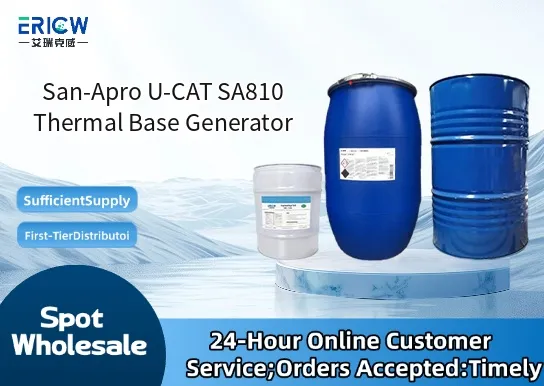
Thermally activated, low-odor amine-free base generator for precise latency and clean curing.
Enables high-gloss, low-haze surface finish in thermoset coatings and encapsulants.
Excellent hydrolytic stability—resists premature decomposition during storage or formulation.
Compatible with common epoxy resins including DGEBA, novolacs, and cycloaliphatic epoxies.
Non-volatile and non-corrosive—supports safer handling and reduced VOC emissions.
High-performance epoxy powder coatings for architectural aluminum and automotive components.
Encapsulants and underfills for semiconductor packaging requiring low ionic contamination.
Electrical insulating varnishes and magnet wire enamels demanding thermal reliability.
Adhesives for aerospace composite bonding where outgassing and thermal aging resistance are critical.
UV/thermal hybrid-cure systems leveraging dual-mechanism crosslinking efficiency.
| Chemical Type | Guanidine-derived thermal base generator |
| Product Form | Free-flowing white to off-white crystalline powder |
| Appearance | Crystalline solid, free of visible lumps or discoloration |
| Melting Point (DSC, onset) | 135–142 °C |
| Onset Decomposition Temperature (TGA, 5% weight loss) | 168–175 °C (N₂ atmosphere) |
| Primary Applications | Epoxy resin curing agent (thermal latent) |
| Key Features | Low volatility, non-halogenated, no amine blush formation |
| Regulatory Compliance | REACH registered; compliant with RoHS 2015/863/EU; no SVHC on candidate list (as of latest update) |
| Common Compatible Systems | Suitability |
| DGEBA-type epoxy resins (e.g., EPON™ 828, YD-128) | Highly Recommended – Rapid gel time control above 140 °C; minimal post-cure shrinkage |
| Cycloaliphatic epoxy resins (e.g., ERL-4221, UVR-6110) | Recommended – Enhanced UV stability synergy; requires 150–160 °C activation |
| Epoxy-novolac resins (e.g., DEN-431, ECN-1273) | Suitable – Effective for high-Tg applications; may require co-catalyst for <130 °C cure profiles |
| Polymercaptan-epoxy hybrid systems | Suitable – Enables dual-cure latency; improves pot life without sacrificing final hardness |
Q1: What is the CAS Registry Number for San-Apro U-CAT SA810?
A: The CAS Registry Number is 2209195-67-2.
Q2: What is the recommended dosage range in epoxy formulations?
A: Typical loading is 0.5–2.0 phr (parts per hundred resin), depending on epoxy functionality, desired gel time, and final Tg requirements. Optimization via DSC is advised.
Q3: How does SA810 compare to conventional DBU-based or imidazole catalysts?
A: SA810 offers superior thermal latency below 130 °C and negligible volatility versus DBU, while providing broader processing windows and lower moisture sensitivity than standard imidazoles.
Q4: Is SA810 compliant with food-contact regulations (e.g., FDA 21 CFR or EU 10/2011)?
A: SA810 is not approved for direct food-contact applications. It is intended for industrial and electronic uses only; migration testing data is not available for food-contact compliance.
Q5: Does SA810 generate extractable amines or ionic residues after full cure?
A: No—SA810 decomposes thermally into non-ionic, non-extractable byproducts; residual ion content (Na⁺, Cl⁻, K⁺) is <5 ppm as measured by IC analysis in fully cured epoxy films.
Contact With Us:
E-mail: wangxingqiang@ericwchem.com
Have a Questions? Call Us:
Add:
Building A1, Jiete Industrial Park, Huangpu District, Guangzhou City, Guangdong Province, China