English
 Español
 tiếng việt
 русский
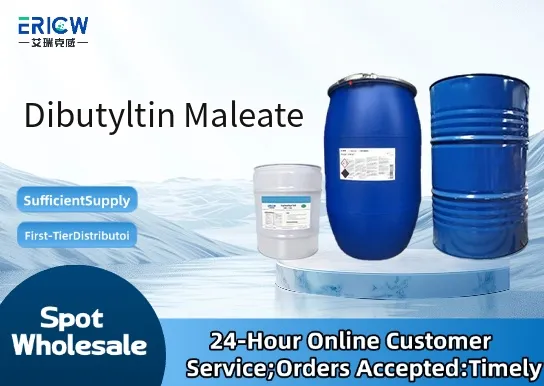
Highly effective thermal stabilizer for polyvinyl chloride (PVC) and its copolymers.
Excellent long-term color retention and reduced discoloration during high-temperature processing.
Low volatility and improved melt stability compared to monobutyltin alternatives.
Good compatibility with common PVC plasticizers including phthalates and adipates.
Non-dusting, free-flowing solid form ensures safe handling and consistent dosing.
Rigid PVC profiles for window frames, siding, and pipe extrusion.
Flexible PVC flooring, wall coverings, and coated fabrics.
Medical-grade PVC tubing and blood bags requiring low extractables.
Automotive interior trims and under-hood components exposed to elevated temperatures.
Wire & cable insulation where thermal stability and electrical performance are critical.
| Chemical Type | Organotin carboxylate (dibutyltin salt of maleic acid) |
| Product Form | White to off-white crystalline powder |
| Appearance | Free-flowing, non-hygroscopic granules |
| Melting Point | 145–152 °C (decomposes above 160 °C) |
| Primary Applications | Thermal stabilizer for rigid and flexible PVC |
| Key Features | Low volatility, high initial color hold, synergistic with epoxidized soybean oil (ESBO) |
| Benefits | Reduces tin migration risk vs. dibutyltin dilaurate; enhances gelation control |
| Regulatory Compliance | Conforms to FDA 21 CFR §178.2010 (for indirect food contact); REACH registered |
| Common Compatible Systems | Suitability |
| PVC homopolymer and copolymers (e.g., PVC/VAc) | Highly Recommended – Excellent dispersion and stabilization efficiency |
| Phthalate-based plasticizer systems (DOP, DIDP) | Highly Recommended – No adverse interaction; improves fusion behavior |
| Epoxidized soybean oil (ESBO) co-stabilizer systems | Recommended – Strong synergism; extends thermal stability window |
| Polyolefin blends (PP/PE) | Suitable – Limited use as secondary stabilizer; requires compatibility testing |
Q1: What is the CAS Number for Dibutyltin Maleate?
A: The CAS Registry Number is 301-10-0.
Q2: What is the typical dosage range in PVC formulations?
A: Standard loading is 0.5–1.5 phr (parts per hundred resin), depending on processing temperature, PVC K-value, and required longevity.
Q3: How does Dibutyltin Maleate compare to Dibutyltin Dilaurate in PVC stabilization?
A: Unlike dibutyltin dilaurate (a catalyst), dibutyltin maleate is specifically designed as a thermal stabilizer with lower volatility, reduced tin leaching, and superior long-term color hold—making it preferred for regulated end uses.
Q4: Is Dibutyltin Maleate compliant with EU RoHS or Prop 65?
A: It contains tin but is not listed as a RoHS-restricted substance; however, it falls under EU CLP hazard classification (H317, H331). It is not subject to Prop 65 listing as of current updates, but users must verify final formulation compliance.
Q5: Does Dibutyltin Maleate exhibit significant migration or extraction in aqueous environments?
A: Migration is markedly lower than liquid organotins due to its ionic, high-melting crystalline structure; validated extraction data show <0.1 ppm tin in 4% acetic acid at 40°C (24h) per EU 10/2011.
Contact With Us:
E-mail: wangxingqiang@ericwchem.com
Have a Questions? Call Us:
Add:
Building A1, Jiete Industrial Park, Huangpu District, Guangzhou City, Guangdong Province, China