English
 Español
 tiếng việt
 русский
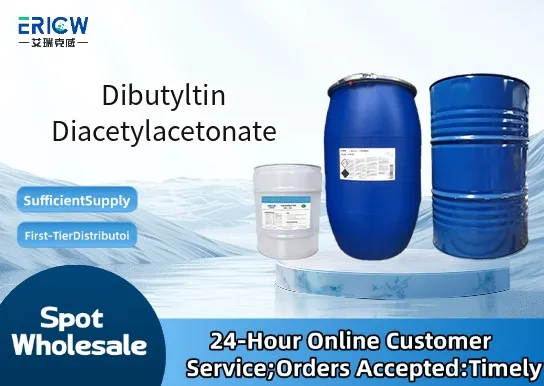
Highly effective tin-based catalyst for polyurethane and silicone condensation cure systems.
Excellent thermal stability with low volatility under processing conditions.
Good solubility in common organic solvents including toluene, xylene, and ketones.
Controlled reactivity profile—delivers consistent gel times without premature scorch.
Low odor and reduced volatility compared to tributyltin compounds, supporting safer handling.
Catalyst in moisture-cure RTV-1 silicone sealants and adhesives.
Accelerator for polyurethane elastomer and coating formulations.
Stabilizer and crosslinking promoter in organosilicon-based release coatings.
Reaction modifier in tin-mediated transesterification processes for specialty polymers.
Co-catalyst in hybrid sol-gel systems for functional surface coatings.
| Chemical Type | Organotin chelate complex |
| Product Form | Pale yellow to amber viscous liquid |
| Appearance | Clear, homogeneous liquid; slight characteristic odor |
| Melting Point | Approx. 50–55 °C (solidifies on cooling; melts readily at ambient handling temperatures) |
| Primary Applications | Condensation-cure catalysis, polyurethane acceleration, silicone crosslinking |
| Key Features | Chelated structure minimizes hydrolysis sensitivity; enhanced shelf-life vs. dialkyltin dihalides |
| Benefits | Improved batch-to-batch consistency, reduced migration risk in cured films, lower acute toxicity profile |
| Regulatory Compliance | REACH registered; compliant with EU RoHS Directive (exemptions apply per Annex III); not classified as CMR under CLP |
| Common Compatible Systems | Suitability |
| Alkoxy-functional silicones (e.g., methyltrimethoxysilane systems) | Highly Recommended – Rapid, reproducible condensation cure with minimal side reactions |
| Aromatic polyisocyanate/polyol PU blends | Recommended – Effective gelling catalyst; compatible with common plasticizers and fillers |
| Acetoxy-cure RTV silicone formulations | Suitable – Provides balanced cure depth and surface tack-free time |
| Hybrid silane-modified polymers (SMPs) | Recommended – Enhances crosslink density without compromising flexibility |
Q1: What is the CAS Registry Number for Dibutyltin Diacetylacetonate?
A: The CAS number is 22751-14-4.
Q2: What is the typical recommended dosage level in silicone sealant formulations?
A: Standard loading ranges from 0.05 to 0.3 phr (parts per hundred resin), depending on desired cure speed, film thickness, and ambient humidity.
Q3: How does Dibutyltin Diacetylacetonate compare to Dibutyltin Dilaurate (DBTDL) in terms of reactivity and regulatory status?
A: DBTDL exhibits higher initial reactivity but greater hydrolytic sensitivity and higher volatility. Dibutyltin diacetylacetonate offers improved hydrolytic stability due to chelation, lower vapor pressure, and a more favorable toxicological profile—making it preferred for applications requiring extended pot life or stricter emission controls.
Q4: Is this compound subject to restrictions under food-contact regulations (e.g., FDA 21 CFR or EU 10/2011)?
A: It is not authorized for direct food-contact applications under current FDA 21 CFR §175.300 or EU Regulation 10/2011. Its use is restricted to non-food-contact industrial sealants, coatings, and adhesives where migration potential is negligible and fully controlled by design.
Q5: Does Dibutyltin Diacetylacetonate exhibit significant leaching or extraction in aqueous environments after full cure?
A: When fully cured in properly formulated systems, leaching is minimal (<0.1 ppm under standard EN 13130 simulation tests). Chelation significantly reduces free tin ion availability versus non-chelated analogues, enhancing resistance to aqueous extraction.
Contact With Us:
E-mail: wangxingqiang@ericwchem.com
Have a Questions? Call Us:
Add:
Building A1, Jiete Industrial Park, Huangpu District, Guangzhou City, Guangdong Province, China