English
 Español
 tiếng việt
 русский
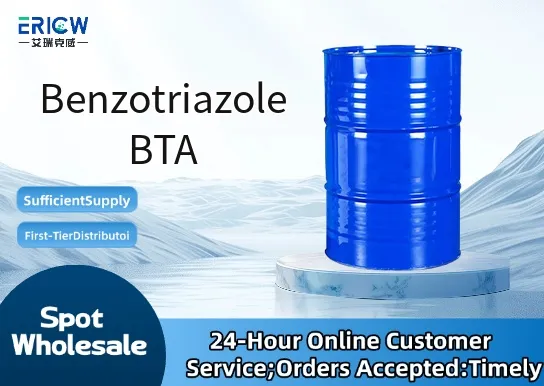
Highly effective copper and brass corrosion inhibitor across a broad pH range (4–10).
Thermally stable up to 250 °C, ensuring performance in high-temperature cooling and heat transfer systems.
Low volatility and minimal water solubility, enabling long-term stability in recirculating aqueous systems.
Non-oxidizing and non-toxic under normal handling conditions, supporting safer industrial use.
Compatible with common biocides, dispersants, and alkalinity builders without significant antagonism.
Cooling water treatment for HVAC and industrial closed-loop systems.
Anticorrosive additive in metalworking fluids (MWFs) for copper-containing alloys.
Stabilizer in photographic developers and electroplating baths to prevent copper oxidation.
Corrosion protection component in automotive antifreeze/coolant formulations.
Additive in polymer stabilizers and UV-absorbing coatings for copper-rich substrates.
| Chemical Type | Heterocyclic aromatic amine (benzotriazole derivative) |
| Product Form | White to off-white crystalline powder |
| Appearance | Crystalline solid, free-flowing granules or fine powder |
| Melting Point | 98–100 °C (ASTM D87) |
| Primary Applications | Copper corrosion inhibition in aqueous systems |
| Key Features | Forms protective chelate layer on copper surfaces; low vapor pressure |
| Benefits | Reduces pitting and dezincification; extends equipment service life |
| Regulatory Compliance | REACH registered; compliant with EU Directive 2004/42/EC (VOC limits) |
| Common Compatible Systems | Suitability |
| Hard water-based cooling systems (pH 7.5–9.0) | Highly Recommended – Forms stable Cu(I)-BTA complex; effective at 1–5 ppm dosage |
| Synthetic metalworking fluid concentrates | Recommended – Stable in emulsified and semi-synthetic formulations; no adverse interaction with EP additives |
| Glycol-water antifreeze mixtures (ethylene/propylene glycol) | Suitable – Soluble upon heating; maintains inhibition efficacy over 2-year service life |
| Low-alkalinity boiler feedwater (pH 6.5–8.5) | Recommended – Effective at sub-ppm levels; compatible with phosphate and silicate treatments |
Q1: What is the CAS Number for Benzotriazole BTA?
A: The CAS Registry Number for 1H-benzotriazole (commonly referred to as BTA) is 90-14-2.
Q2: What is the typical dosage range for effective copper corrosion inhibition?
A: Standard dosage is 1–5 mg/L (ppm) in recirculating cooling water; higher concentrations (up to 10 ppm) may be used during system passivation or in aggressive chloride-containing environments.
Q3: How does Benzotriazole BTA compare to tolyltriazole (TTA) in performance and regulatory status?
A: BTA offers slightly stronger copper affinity than TTA but has higher aquatic toxicity (OECD 201); TTA is often preferred where environmental discharge limits apply. Both are functionally interchangeable in most industrial formulations.
Q4: Is Benzotriazole BTA subject to SVHC or PBT listing under REACH?
A: Benzotriazole (CAS 90-14-2) is listed as a Substance of Very High Concern (SVHC) under REACH due to its persistent, bioaccumulative, and toxic (PBT) properties — authorization is required for certain uses after inclusion in Annex XIV.
Q5: Can Benzotriazole BTA migrate from treated polymers or coatings into food or water simulants?
A: Yes — BTA exhibits measurable migration in aqueous and acidic food simulants (e.g., 3% acetic acid) per EU Regulation (EC) No 10/2011; migration limits apply (SML = 0.05 mg/kg food).
Contact With Us:
E-mail: wangxingqiang@ericwchem.com
Have a Questions? Call Us:
Add:
Building A1, Jiete Industrial Park, Huangpu District, Guangzhou City, Guangdong Province, China