English
 Español
 tiếng việt
 русский
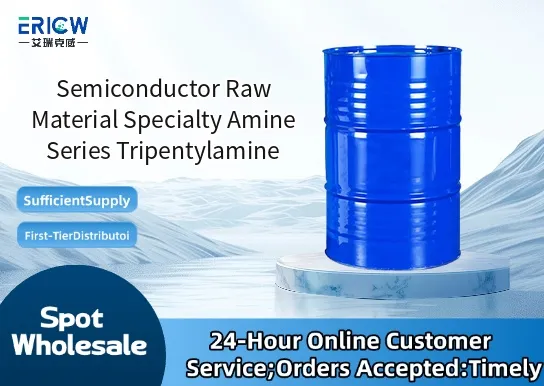
Ultra-low metal impurity profile (<10 ppb Na, K, Ca, Fe, Ni, Cu), critical for high-purity semiconductor processing.
Highly selective amine functionality enabling precise pH control and metal ion chelation in advanced etch and clean formulations.
Exceptional thermal stability (decomposition onset >220 °C), supporting compatibility with high-temperature semiconductor fabrication steps.
Low volatility and negligible vapor pressure at room temperature, minimizing airborne molecular contamination (AMC) risk in cleanroom environments.
Batch-to-batch reproducibility certified per ISO 9001 and SEMI S2/S8 standards, ensuring process consistency in fab-scale deployment.
Advanced photoresist development accelerators for EUV lithography processes.
Stabilizing agent in copper CMP (chemical mechanical planarization) slurries to suppress dishing and erosion.
Chelating component in high-selectivity silicon oxide etchants for sub-5 nm node patterning.
Corrosion inhibitor in post-etch residue removal solutions for low-k dielectric stacks.
Additive in wafer-level packaging underfill formulations to enhance interfacial adhesion and moisture resistance.
| Chemical Type | Tertiary aliphatic amine (tri-n-pentylamine) |
| Molecular Formula | C₁₅H₃₃N |
| Product Form | Pale yellow to colorless liquid |
| Appearance | Clear, homogeneous, free of suspended particles or phase separation |
| Melting Point | −65 °C (typical) |
| Boiling Point (760 mmHg) | 292–295 °C |
| Primary Applications | Photoresist additives, CMP slurry stabilizers, etch enhancers, corrosion inhibitors |
| Regulatory Compliance | REACH registered; RoHS compliant; non-REACH SVHC; SDS available per GHS Rev.10 |
| Common Compatible Systems | Suitability |
| Aqueous-based photoresist developer concentrates (TMAH alternatives) | Highly Recommended – Demonstrated compatibility with 0.1–2.38% TMAH replacement formulations |
| Copper CMP slurries (silica/colloidal silica abrasive systems) | Highly Recommended – Effective stabilization without altering zeta potential or slurry rheology |
| Hydrofluoric acid (HF)-based oxide etchants (dilute and buffered) | Recommended – Enhances selectivity when dosed at ≤50 ppm; requires pH monitoring |
| Epoxy-acrylate hybrid underfill resins | Suitable – Improves wetting on Cu/OSP surfaces; validated up to 1.5 wt% loading |
Q1: What is the CAS Registry Number for Tripentylamine?
A: The CAS number is 102-81-8. Each production lot undergoes GC-MS identity confirmation and certificate of analysis (CoA) verification.
Q2: What is the recommended dosage range in photoresist developer formulations?
A: Typical dosage is 10–200 ppm (w/w) relative to total developer volume. Optimal concentration depends on resist chemistry and target dissolution rate; we recommend DOE-based qualification per process step.
Q3: How does Tripentylamine compare to triethylamine (TEA) or triethanolamine (TEA) in semiconductor applications?
A: Tripentylamine offers significantly lower volatility (vapor pressure ≈0.001 mmHg at 25 °C vs. 50 mmHg for TEA), reduced AMC generation, higher hydrophobicity for interface-selective action, and superior thermal resilience—making it preferred for EUV and advanced packaging where TEA’s volatility and residue risk are unacceptable.
Q4: Is Tripentylamine subject to leaching or extractables in contact with fluoropolymer fluidic components (e.g., PFA, FEP)?
A: No significant leaching observed under standard fab conditions (≤60 °C, pH 10–12). Compatibility testing per SEMI F57 confirms <1 ppb organic extractables from PFA tubing after 72-hr static exposure at 40 °C.
Q5: Does Tripentylamine require special handling for electrostatic discharge (ESD) or particulate control?
A: Yes. As a low-conductivity organic liquid (conductivity <1 pS/m), it must be transferred using grounded, stainless-steel or conductive fluoropolymer equipment. Particulate levels are controlled to ≤1 particle/mL ≥0.2 μm (per ISO 14644-1 Class 3) in final packaged product.
Contact With Us:
E-mail: wangxingqiang@ericwchem.com
Have a Questions? Call Us:
Add:
Building A1, Jiete Industrial Park, Huangpu District, Guangzhou City, Guangdong Province, China