English
 Español
 tiếng việt
 русский
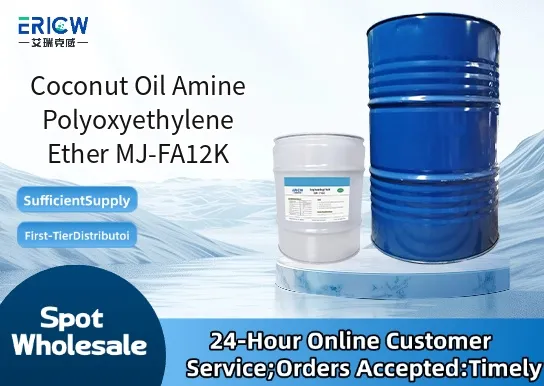
Nonionic surfactant derived from renewable coconut oil amine, offering excellent biodegradability and low ecotoxicity.
Superior emulsification and dispersion performance in both acidic and alkaline media (pH 3–12).
Low foaming profile with stable performance under high-shear and elevated temperature conditions.
Enhanced wetting and surface tension reduction (<28 mN/m at 0.1% aqueous solution, 25°C).
Excellent compatibility with cationic, anionic, and nonionic co-surfactants without precipitation.
Agrochemical formulations: adjuvant for herbicides, fungicides, and insecticides to improve foliar spread and uptake.
Industrial cleaning agents: key solubilizer and grease-cutting component in metalworking fluid concentrates.
Textile auxiliaries: leveling agent and dye dispersant in reactive and disperse dyeing systems.
Personal care emulsions: mild co-emulsifier in sulfate-free shampoos and cream rinses.
Water-based coatings: stabilizer for pigment dispersions and rheology modifier in architectural and industrial paints.
| Chemical Type | Fatty amine ethoxylate (C12–C14 primary amine, ~12 EO units) |
| Product Form | Viscous amber liquid |
| Appearance | Clear to slightly hazy, free from visible particulates |
| Active Content | 95–98% (by weight, titration) |
| pH (1% aqueous solution, 25°C) | 6.0–7.5 |
| Cloud Point (1% aqueous solution) | 72–78°C |
| Hydrophilic-Lipophilic Balance (HLB) | 12.5–13.2 |
| Regulatory Compliance | REACH registered; compliant with EU Cosmetics Regulation (EC) No 1223/2009 (non-restricted); listed on TSCA Inventory |
| Common Compatible Systems | Suitability |
| Alkylphenol ethoxylate (APEO)-free formulations | Highly Recommended – Designed as direct APEO replacement with superior environmental profile |
| Nonionic-anionic blends (e.g., LAS + alcohol ethoxylates) | Highly Recommended – No phase separation or viscosity instability observed up to 30% active loading |
| Cationic quaternary ammonium systems (e.g., alkyltrimethylammonium chloride) | Recommended – Stable below pH 8.5; avoid prolonged heating >60°C to prevent amine oxide formation |
| High-electrolyte environments (e.g., fertilizer concentrates, >15% salt) | Suitable – Maintains solubility but may require co-solvent (e.g., propylene glycol) above 10% NaCl |
Q1: What is the CAS Registry Number for MJ-FA12K?
A: The CAS number is 68439-51-4 (generic for C12–C14 coconut amine ethoxylates with ~12 EO); batch-specific CAS verification available upon request.
Q2: What is the recommended use level in agrochemical spray solutions?
A: Typical dosage ranges from 0.1% to 0.5% (v/v) in final tank mix; optimal concentration depends on active ingredient hydrophobicity and water hardness—conduct jar test before full-scale use.
Q3: How does MJ-FA12K compare to linear alcohol ethoxylates (e.g., AE07–10) in terms of foam control and wetting speed?
A: MJ-FA12K delivers faster initial wetting (≤2 seconds on paraffin-coated surfaces) and significantly lower dynamic foam generation versus AE07–10, due to its amine headgroup geometry and reduced interfacial elasticity.
Q4: Is MJ-FA12K suitable for food-contact surface cleaners regulated under FDA 21 CFR §178.3400?
A: Yes — MJ-FA12K meets FDA 21 CFR §178.3400 requirements for indirect food additives when used ≤0.1% in final rinseable formulations; full compliance documentation available under NDA.
Q5: Does MJ-FA12K exhibit migration or leaching in polymer-based packaging films during storage?
A: No significant migration observed in HDPE, LDPE, or PP films per ASTM D1249 testing at 40°C/75% RH for 30 days; negligible extractables (<0.5 ppm) confirmed by GC-MS analysis.
Contact With Us:
E-mail: wangxingqiang@ericwchem.com
Have a Questions? Call Us:
Add:
Building A1, Jiete Industrial Park, Huangpu District, Guangzhou City, Guangdong Province, China