English
 Español
 tiếng việt
 русский
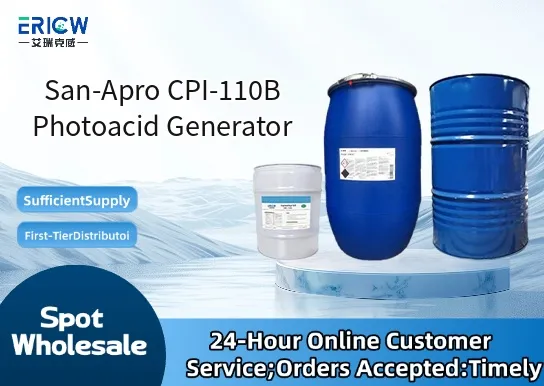
High quantum yield photoacid generation under 365 nm (i-line) and 248 nm (KrF) exposure.
Excellent thermal stability—decomposition onset >180 °C—enabling robust post-apply bake (PAB) and post-exposure bake (PEB) processing.
Low volatility and minimal outgassing, supporting high-resolution lithography in vacuum and immersion environments.
High purity (>99.5% by HPLC) with tightly controlled trace metal impurities (<10 ppb each of Na, K, Fe, Cu).
Soluble in common photoresist casting solvents including propylene glycol monomethyl ether acetate (PGMEA) and ethyl lactate.
Chemically amplified resists (CARs) for advanced semiconductor lithography at 28 nm to 7 nm technology nodes.
High-resolution negative-tone and positive-tone deep-UV (DUV) photoresists.
Advanced packaging lithography, including redistribution layer (RDL) and fan-out wafer-level packaging (FO-WLP) applications.
MEMS and microfluidic device fabrication requiring precise pattern fidelity and low line-edge roughness (LER).
Optical waveguide and photonic integrated circuit (PIC) patterning processes.
| Chemical Type | Sulfonium salt (triphenylsulfonium nonaflate derivative) |
| Product Form | White to off-white crystalline powder |
| Appearance | Free-flowing crystalline solid |
| Melting Point | 162–167 °C (DSC, onset) |
| Primary Applications | Photoacid generator for DUV and EUV chemically amplified resists |
| Key Features | High acid strength (H₀ ≈ –12), rapid deprotection kinetics, low diffusion during PEB |
| Benefits | Enables high sensitivity (≤10 mJ/cm²), improved resolution, and reduced LER |
| Regulatory Compliance | REACH compliant; RoHS 2 Directive (2011/65/EU) conformant; no SVHC on current Candidate List |
| Common Compatible Systems | Suitability |
| Standard novolac-DNQ resists (modified with CAR components) | Recommended – Effective as co-PAG in hybrid resist formulations |
| Acrylic-based chemically amplified resists (e.g., poly(hydroxystyrene-co-tert-butoxycarbonyloxystyrene)) | Highly Recommended – Optimal compatibility and performance balance |
| Alkali-soluble phenolic resin systems with lactone additives | Suitable – Requires optimization of PEB temperature and time |
| Non-chemically amplified UV-curable coatings | Not Recommended – Incompatible with non-acid-catalyzed mechanisms |
Q1: What is the CAS Registry Number for San-Apro CPI-110B?
A: The CAS number is 1820857-41-1.
Q2: What is the typical loading range in photoresist formulations?
A: Standard concentration ranges from 1.5 to 5.0 wt% relative to total solid content, depending on resist architecture and target sensitivity.
Q3: How does CPI-110B compare to triphenylsulfonium triflate (TPT) in terms of acid diffusion control?
A: CPI-110B exhibits lower acid diffusivity due to its bulkier nonaflate counteranion, resulting in superior resolution and reduced pattern collapse versus TPT under identical PEB conditions.
Q4: Is CPI-110B subject to migration or extractable residue concerns in contact with electronic-grade solvents?
A: No significant migration observed in PGMEA, EL, or cyclohexanone after 72-hour storage at 25 °C; validated via IC-MS analysis per SEMI F57 standards.
Q5: Does San-Apro provide regulatory documentation (e.g., SDS, IFRA, TSCA status) for CPI-110B?
A: Yes—full SDS (GHS-compliant), TSCA inventory verification letter, and REACH SCIP notification documentation are available upon request to qualified customers.
Contact With Us:
E-mail: wangxingqiang@ericwchem.com
Have a Questions? Call Us:
Add:
Building A1, Jiete Industrial Park, Huangpu District, Guangzhou City, Guangdong Province, China