English
 Español
 tiếng việt
 русский
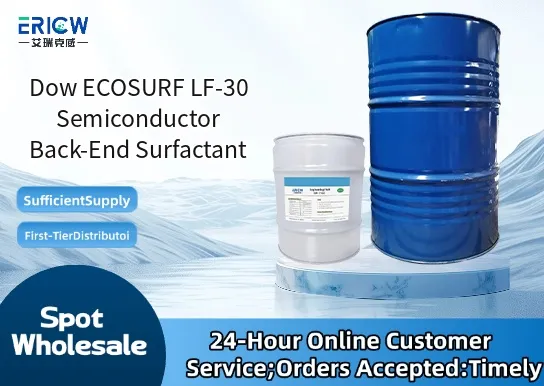
Ultra-low residue formulation engineered specifically for semiconductor back-end cleaning and rinse processes.
Exceptional surface tension reduction in deionized water at low concentrations (0.01–0.1 wt%).
Non-ionic, alcohol ethoxylate-based chemistry with minimal ionic impurities (<1 ppm Na⁺, K⁺, Cl⁻).
High thermal and hydrolytic stability across typical BEOL process temperature ranges (20–60 °C).
Compatible with advanced packaging materials including low-k dielectrics, copper interconnects, and polyimide passivation layers.
Post-CMP (Chemical Mechanical Planarization) rinse for copper and barrier metal removal.
Wafer-level cleaning prior to underfill or molding compound application.
Rinse aid in wafer dicing and singulation processes to suppress particle redeposition.
Surface energy modification for improved adhesion of encapsulants and underfills.
Low-residue surfactant additive in aqueous-based temporary bonding/debonding chemistries.
| Chemical Type | Non-ionic alcohol ethoxylate (C12–C15, avg. EO = 7) |
| Product Form | Pale yellow to colorless liquid |
| Appearance | Clear, homogeneous liquid at 25 °C |
| Active Content | 98–100 wt% (by GC analysis) |
| Primary Applications | Semiconductor back-end-of-line (BEOL) cleaning, rinsing, and surface conditioning |
| Key Features | Ultra-low ionic residue, low foaming, high DI water solubility |
| Benefits | Reduces pattern collapse, minimizes microcontamination, enhances drying uniformity |
| Regulatory Compliance | REACH registered; RoHS 2015/863 compliant; no SVHCs above threshold |
| Common Compatible Systems | Suitability |
| Deionized (DI) Water Rinse Systems | Highly Recommended – Optimized for ultra-low conductivity and residue control |
| Copper CMP Slurry Post-Clean Chemistries | Recommended – Compatible with common acidic and neutral post-CMP formulations |
| Temporary Bonding Adhesives (e.g., Dow DBC series) | Suitable – Does not interfere with thermal debonding performance or interface integrity |
| Underfill Encapsulants (epoxy & capillary types) | Recommended – Improves wetting without compromising cure kinetics or reliability |
Q1: What is the CAS Registry Number for Dow ECOSURF LF-30?
A: The CAS number is 9002-93-1 (generic for C12–C15 alcohol ethoxylates, EO≈7); batch-specific analytical certificates are provided with each shipment.
Q2: What is the recommended use concentration in DI water rinse applications?
A: Typical dosage ranges from 0.02 to 0.05 wt% (200–500 ppm); optimization is required per tool configuration and defect sensitivity requirements.
Q3: How does ECOSURF LF-30 compare to ECOSURF EH-9 in semiconductor applications?
A: LF-30 offers lower foam, higher thermal stability, and stricter ionic purity vs. EH-9; it is formulated specifically for BEOL, whereas EH-9 targets broader industrial cleaning.
Q4: Is ECOSURF LF-30 subject to outgassing or extractables concerns in high-vacuum packaging environments?
A: No — validated per SEMI F57 and JEDEC JESD22-A109; total volatile condensable materials (CVCM) <0.1%, and no detectable extractables via LC-MS after 24-hr DI water leaching at 40 °C.
Q5: Does ECOSURF LF-30 require special handling or storage conditions?
A: Store at 10–30 °C in original sealed container; avoid prolonged exposure to temperatures >40 °C or direct sunlight. No special PPE beyond standard lab gloves and eye protection is required.
Contact With Us:
E-mail: wangxingqiang@ericwchem.com
Have a Questions? Call Us:
Add:
Building A1, Jiete Industrial Park, Huangpu District, Guangzhou City, Guangdong Province, China