English
 Español
 tiếng việt
 русский
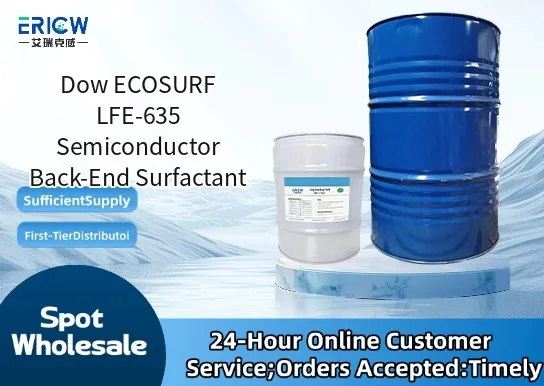
Ultra-low ionic residue profile optimized for post-CMP cleaning and wafer back-end-of-line (BEOL) processes.
Nonionic, alcohol-ethoxylate-based chemistry with high hydrolytic stability under neutral-to-mildly alkaline conditions.
Exceptional particle dispersion and redeposition control on low-k dielectrics and copper interconnects.
Designed for compatibility with advanced photoresist stripping and wet etch rinse formulations.
Low foaming behavior suitable for high-throughput spin-rinse-dry (SRD) and megasonic immersion tools.
Copper and cobalt post-CMP cleaning in advanced logic and memory device manufacturing (≤7 nm nodes).
Rinse aid in BEOL-compatible resist ashing and plasma etch residue removal solutions.
Stabilizer in dilute SC1 (NH₄OH:H₂O₂:H₂O) variants for ultra-clean wafer surface preparation.
Co-formulant in low-surface-tension, low-metal-content rinse additives for TSV and 3D packaging processes.
Enabling agent for defect-free drying of high-aspect-ratio structures during final wafer rinse steps.
| Chemical Type | Nonionic alcohol ethoxylate (C₁₂–C₁₅ linear primary alcohol, ~6.5 EO units) |
| Product Form | Clear, viscous liquid at 25 °C |
| Appearance | Colorless to pale yellow, homogeneous liquid |
| pH (1% aqueous solution, 25 °C) | 6.0 – 7.5 |
| Primary Applications | Semiconductor back-end-of-line (BEOL) cleaning, CMP rinse, post-etch residue management |
| Key Features | Low sodium/cationic metal content (<1 ppm), ultra-low chloride (<50 ppb), non-volatile residue <0.05% |
| Benefits | Minimizes pattern collapse, suppresses micro-bridging, enhances drying uniformity on hydrophobic surfaces |
| Regulatory Compliance | REACH registered; RoHS compliant; no SVHCs above threshold per current candidate list |
| Common Compatible Systems | Suitability |
| Dilute SC1 (NH₄OH:H₂O₂:H₂O, 1:1:5–1:1:50) | Highly Recommended – Maintains colloidal stability and oxide etch rate control |
| Acidic citrate-based post-CMP slurries | Recommended – Effective in pH 4–6 formulations with minimal chelation interference |
| Low-pH organic amine strippers (e.g., MEA/HEP derivatives) | Suitable – No phase separation or precipitation observed below 5 wt% loading |
| Deionized water (DIW) rinse systems with megasonic agitation | Highly Recommended – Enhances surface tension reduction without foam carryover |
Q1: What is the CAS Registry Number for ECOSURF LFE-635?
A: The CAS Registry Number is 1344972-58-7.
Q2: What is the recommended use concentration in BEOL rinse formulations?
A: Typical dosage ranges from 0.05 to 0.5 wt% in final process solutions, depending on tool configuration and substrate hydrophobicity—validated down to 20 ppm for high-precision SRD applications.
Q3: How does LFE-635 compare to ECOSURF EH-15 in semiconductor applications?
A: LFE-635 offers lower HLB (~12.5 vs. EH-15’s ~13.8), reduced volatility, and tighter ionic impurity control—specifically engineered for BEOL thermal budgets and low-k dielectric compatibility where EH-15 is more suited for front-end-of-line (FEOL) pre-gate cleaning.
Q4: Is LFE-635 certified for use in ISO Class 1 cleanroom environments?
A: Yes—manufactured and packaged under ISO 14644-1 Class 5 conditions; certified particulate-free (<1 particle/mL ≥0.2 µm) and metals-tested per SEMI F57 standards.
Q5: Does LFE-635 exhibit extractables or leachables in contact with PTFE or fluoropolymer fluid-handling components?
A: No significant extractables detected per SEMI F63 testing; compatible with standard perfluoroalkoxy (PFA), ETFE, and FEP wetted materials across 5–45 °C operating range.
Contact With Us:
E-mail: wangxingqiang@ericwchem.com
Have a Questions? Call Us:
Add:
Building A1, Jiete Industrial Park, Huangpu District, Guangzhou City, Guangdong Province, China