English
 Español
 tiếng việt
 русский
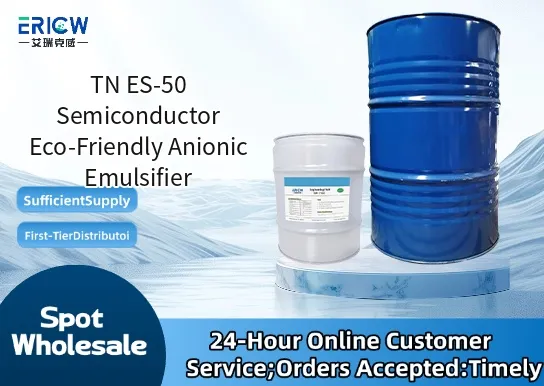
Highly effective anionic surfactant specifically engineered for semiconductor-grade aqueous cleaning and dispersion processes.
Zero APEO (alkylphenol ethoxylates), halogen-free, and readily biodegradable per OECD 301B standards.
Ultra-low residue profile with negligible metal ion content (Na⁺, K⁺, Ca²⁺ < 1 ppm), critical for wafer surface integrity.
Exceptional hydrolytic stability across pH 4–10 and temperatures up to 60 °C, ensuring process consistency.
Non-foaming formulation optimized for high-shear recirculating systems and ultrasonic immersion baths.
Photoresist stripper co-emulsifier in low-damage, post-etch residue removal formulations.
Stabilizer for nano-silica and ceria-based CMP slurries in advanced node polishing applications.
Wetting and dispersing agent in aqueous-based dielectric cleaning solutions for BEOL integration.
Emulsification aid for perfluoropolyether (PFPE) lubricant microemulsions in MEMS device manufacturing.
Surfactant component in ultra-pure rinse additives for particle removal without re-deposition.
| Chemical Type | Sulfosuccinate-based anionic surfactant (branched alkyl ester) |
| Product Form | Clear, viscous liquid |
| Appearance | Colorless to pale yellow, homogeneous liquid |
| pH (1% aqueous solution, 25 °C) | 6.2 – 6.8 |
| Active Content (by weight) | ≥ 48.0% |
| Primary Applications | Semiconductor wet processing: cleaning, emulsification, dispersion, rinsing |
| Key Features | Low foaming, ultra-low ionic impurities, APEO-free, non-volatile organic residue (NVOR) compliant |
| Regulatory Compliance | REACH registered; RoHS 2.0 compliant; no SVHCs on ECHA Candidate List (as of 2024-10) |
| Common Compatible Systems | Suitability |
| Aqueous alkaline photoresist removers (e.g., TMAH-based) | Highly Recommended – Excellent solubility and stability without precipitation or phase separation |
| CMP slurry systems (SiO₂, CeO₂, Al₂O₃) | Highly Recommended – Enhances particle dispersion and reduces agglomeration at 0.05–0.2 wt% |
| Deionized water-based rinse additives | Recommended – Effective at 0.01–0.05 wt%; requires dilution control to maintain resistivity > 18.2 MΩ·cm |
| Mild organic solvent blends (e.g., PGMEA/water mixtures) | Suitable – Partially miscible; stable below 15% organic content; not recommended for >30% solvent systems |
Q1: What is the CAS Registry Number for TN ES-50?
A: The CAS Number for TN ES-50 is 127287-94-1 (registered under its primary sulfosuccinate diester composition).
Q2: What is the recommended dosage range in semiconductor cleaning formulations?
A: Typical use level is 0.03–0.15 wt% in final process solutions; optimal concentration depends on substrate, soil type, and equipment design—validation via SPM/SC1 compatibility testing is advised.
Q3: How does TN ES-50 compare to traditional linear alkylbenzene sulfonates (LAS) in semiconductor applications?
A: Unlike LAS, TN ES-50 delivers superior low-residue performance, lower ecotoxicity, higher hydrolytic stability, and no aromatic hydrocarbon content—making it suitable for sub-7nm node processes where LAS-induced contamination is unacceptable.
Q4: Is TN ES-50 compliant with JEDEC J-STD-020 and IEC 60112 for material migration and extractables testing?
A: Yes—validated per JEDEC J-STD-020D (MSL 1) for moisture sensitivity, and IEC 60112 tracking index ≥ 600 V; extractables testing (per SEMI F57) confirms < 0.5 ppb Na⁺, < 0.3 ppb Cl⁻, and < 1.0 ppb total metals in DI water leachates.
Contact With Us:
E-mail: wangxingqiang@ericwchem.com
Have a Questions? Call Us:
Add:
Building A1, Jiete Industrial Park, Huangpu District, Guangzhou City, Guangdong Province, China