English
 Español
 tiếng việt
 русский
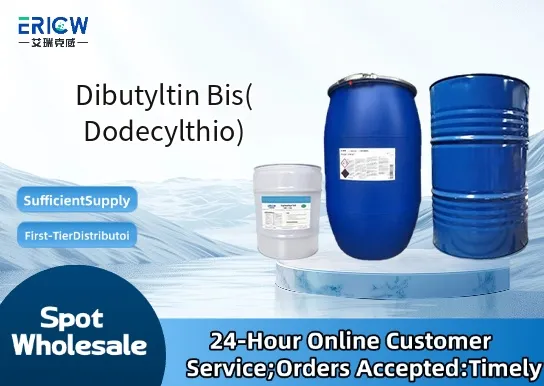
High thermal and hydrolytic stability under processing conditions typical for PVC stabilization.
Effective long-term heat stabilizer with low volatility and minimal odor generation.
Excellent compatibility with polyvinyl chloride (PVC) and related chlorinated polymers.
Acts as a secondary stabilizer by scavenging labile chlorine and suppressing dehydrochlorination.
Provides synergistic performance when combined with primary Ca/Zn or Ba/Zn stabilizers.
Rigid PVC profiles for window frames and siding requiring high-temperature extrusion stability.
Flexible PVC compounds used in wire & cable insulation and automotive interior trim.
Transparent PVC sheets and films where color retention and clarity are critical.
PVC flooring and wall coverings demanding consistent melt behavior and low plate-out.
Specialty PVC formulations for medical tubing and packaging where extractable tin content must be tightly controlled.
| Chemical Type | Organotin compound — dialkyltin dithiolate |
| Product Form | Pale yellow to light amber viscous liquid or semi-solid paste at room temperature |
| Appearance | Clear, homogeneous liquid or soft solid; slight characteristic sulfurous odor |
| Melting Point / Softening Range | 35–45 °C (determined by DSC or capillary method) |
| Primary Applications | Secondary heat stabilizer for rigid and flexible PVC |
| Key Features | Low volatility, good dispersion, effective chlorine scavenging |
| Benefits | Enhances long-term thermal stability, reduces discoloration, minimizes plate-out |
| Regulatory Compliance | Conforms to REACH Annex XVII restrictions on organotin compounds (exempted for industrial PVC stabilization under specific concentration limits) |
| Common Compatible Systems | Suitability |
| Ca/Zn-based PVC stabilizer systems | Highly Recommended – Enhances long-term thermal stability without antagonism |
| Barium-containing PVC formulations | Recommended – Effective synergy in rigid PVC extrusion grades |
| PVC plastisols (with compatible dispersants) | Suitable – Requires pre-dispersion or high-shear mixing for uniform distribution |
| Acrylic impact modifiers (e.g., MBS, ABS) | Recommended – No adverse interaction observed in compounded blends |
Q1: What is the CAS Number for Dibutyltin Bis(Dodecylthio)?
A: The CAS Registry Number is 3627-69-2.
Q2: What is the typical dosage range in PVC formulations?
A: Usual loading is 0.1–0.5 phr (parts per hundred resin), depending on polymer grade, processing temperature, and required stabilization lifetime.
Q3: How does it compare to monobutyltin or tributyltin derivatives?
A: Dibutyltin derivatives offer superior thermal stability and lower mammalian toxicity compared to tributyltin, while maintaining higher efficacy than monobutyltin analogues in PVC stabilization.
Q4: Is it compliant with food-contact regulations?
A: Not approved for direct food-contact applications under FDA 21 CFR or EU Regulation (EC) No 10/2011; intended exclusively for industrial PVC stabilization where migration is rigorously controlled and verified.
Q5: Does it contribute to tin migration or extraction in end-use products?
A: Migration potential is low due to high molecular weight and strong coordination with PVC matrix; however, regulatory-compliant testing (e.g., EN 1186, ISO 17775) is required for each final application.
Contact With Us:
E-mail: wangxingqiang@ericwchem.com
Have a Questions? Call Us:
Add:
Building A1, Jiete Industrial Park, Huangpu District, Guangzhou City, Guangdong Province, China