English
 Español
 tiếng việt
 русский
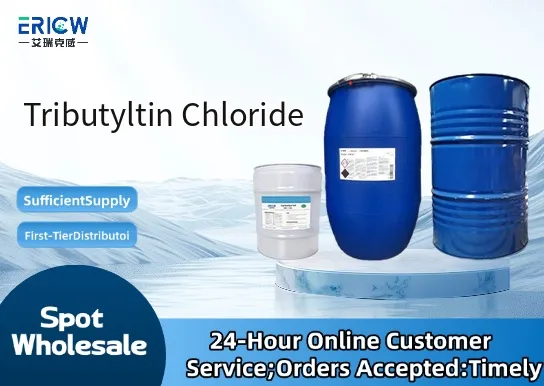
Highly effective biocidal agent against marine fouling organisms, including barnacles, mussels, and algae.
Thermal and hydrolytic stability under controlled storage conditions (anhydrous, inert atmosphere).
Strong affinity for polymeric matrices, enabling durable incorporation into antifouling coatings.
Low volatility compared to other organotin compounds, supporting safer handling in formulation processes.
Precise stoichiometric reactivity for synthesis of tributyltin derivatives (e.g., oxides, carboxylates).
Intermediate in the production of tributyltin oxide (TBTO), a key active ingredient in marine antifouling paints.
Catalyst for esterification and transesterification reactions in silicone and polyester synthesis.
Stabilizer precursor for polyvinyl chloride (PVC) in specialized high-temperature applications.
Reagent in organic synthesis for tin–carbon bond formation and selective alkylation.
Component in research-grade formulations for corrosion inhibition studies in saline environments.
| Chemical Type | Organotin compound (triorganotin chloride) |
| Product Form | White to off-white crystalline solid or low-melting waxy mass |
| Appearance | Crystalline powder or translucent flakes |
| Melting Point | 50–55 °C (literature range; sensitive to purity and hydration) |
| Primary Applications | Antifouling paint intermediate, PVC stabilizer precursor, synthetic reagent |
| Key Features | High purity (>97.0%), low residual tin oxide content, moisture-sensitive |
| Benefits | Consistent reactivity, batch-to-batch reproducibility, compatibility with common organic solvents |
| Regulatory Compliance | Complies with REACH pre-registration (EU); not authorized for biocidal use in EU waters per BPR Annex I |
| Common Compatible Systems | Suitability |
| Aromatic hydrocarbon solvents (e.g., xylene, toluene) | Highly Recommended – Excellent solubility and stability under anhydrous conditions |
| Chlorinated solvents (e.g., chlorobenzene, dichloromethane) | Recommended – Good dissolution; avoid prolonged exposure to moisture |
| Polyvinyl chloride (PVC) melt matrix | Suitable – Effective as thermal stabilizer precursor at controlled processing temperatures (<180 °C) |
| Acrylic-based antifouling binders | Recommended – Requires co-stabilizers and strict moisture control during incorporation |
Q1: What is the CAS Number for Tributyltin Chloride?
A: The CAS Registry Number is 1461-22-9.
Q2: Is Tributyltin Chloride approved for use in antifouling paints globally?
A: No — its use in marine antifouling coatings is banned in the EU, US, Australia, and most OECD countries under IMO AFS Convention and national regulations due to environmental persistence and toxicity to non-target marine life.
Q3: How does Tributyltin Chloride compare to Tributyltin Oxide (TBTO) in terms of reactivity and handling?
A: Tributyltin Chloride is more reactive and moisture-sensitive than TBTO; it serves as a direct precursor to TBTO via hydrolysis but requires stricter anhydrous handling and inert-atmosphere storage.
Q4: Can Tributyltin Chloride migrate from polymer matrices into aqueous environments?
A: Yes — under humid or immersed conditions, hydrolysis can release bioactive tributyltin cations; migration potential is significantly higher than in covalently bound or oxidized forms, necessitating rigorous leaching controls in regulatory testing.
Contact With Us:
E-mail: wangxingqiang@ericwchem.com
Have a Questions? Call Us:
Add:
Building A1, Jiete Industrial Park, Huangpu District, Guangzhou City, Guangdong Province, China