English
 Español
 tiếng việt
 русский
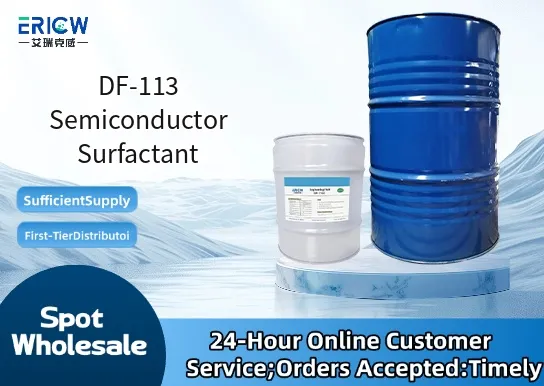
Ultra-low ionic residue for minimal metal ion contamination in critical semiconductor cleaning processes.
Exceptional wetting and penetrating capability on hydrophobic silicon wafers and low-k dielectrics.
Thermally stable up to 120 °C, enabling compatibility with high-temperature rinse and drying steps.
Non-foaming formulation designed specifically for megasonic and spray-based wafer cleaning equipment.
Readily biodegradable under aerobic conditions (OECD 301D compliant), supporting sustainable manufacturing goals.
Post-etch residue removal for advanced logic and memory device fabrication (≤5 nm node).
Photoresist stripping aid in aqueous-based chemistries for high-aspect-ratio structures.
Pre-deposition surface conditioning prior to ALD or CVD of high-k gate oxides.
Particle lift-off enhancement during final rinse in front-end-of-line (FEOL) processing.
Defect reduction in copper CMP post-clean formulations for interconnect metallization.
| Chemical Type | Nonionic surfactant blend (alkyl polyglucoside & modified ethoxylated alcohol) |
| Product Form | Aqueous solution (35 wt% active) |
| Appearance | Clear, colorless to pale yellow liquid |
| pH (1% aqueous, 25 °C) | 6.8–7.4 |
| Primary Applications | Wafer cleaning, residue removal, surface conditioning in semiconductor manufacturing |
| Key Features | Low volatility, non-corrosive to aluminum and copper, ultra-low sodium/potassium content (<1 ppm) |
| Benefits | Reduces pattern collapse, improves uniformity of thin-film deposition, lowers defect density (k1 < 0.25) |
| Regulatory Compliance | REACH registered; RoHS 2015/863 compliant; no SVHCs above 0.1 wt% |
| Common Compatible Systems | Suitability |
| Megasonic cleaning baths (170–950 kHz) | Highly Recommended – Maintains cavitation efficiency without foam interference |
| Aqueous alkaline etch residues (e.g., TEA-based) | Recommended – Enhances solubilization without precipitation |
| Deionized water (DIW) rinse systems | Highly Recommended – Fully miscible; no phase separation or film formation |
| Standard photoresist strippers (e.g., NMP-free formulations) | Suitable – Improves residue lift without impacting strip rate |
Q1: What is the CAS Registry Number for DF-113 Semiconductor Surfactant?
A: DF-113 is a proprietary multi-component formulation; individual constituents have CAS numbers (e.g., alkyl polyglucoside: 13171-18-1), but the blended product is assigned a unique internal batch ID for traceability—not a single CAS number.
Q2: What is the recommended dosage range in wafer cleaning formulations?
A: Typical use concentration is 0.1–0.5 wt% in DIW-based process solutions; optimal dosage is validated per tool configuration and residue type—start at 0.2 wt% and adjust based on particle count (SEMI F57) and surface energy (contact angle < 5°).
Q3: How does DF-113 compare to conventional fluorosurfactants in terms of environmental impact and performance?
A: Unlike PFAS-containing fluorosurfactants, DF-113 contains zero fluorinated carbon chains and exhibits rapid aerobic biodegradation (>65% in 28 days). It matches fluorosurfactants in contact angle reduction on SiO₂ but avoids long-term bioaccumulation concerns and regulatory restrictions.
Q4: Has DF-113 been tested for extractables/migratables in high-purity process lines?
A: Yes—validated per SEMI F63 (ultra-trace elemental analysis) and USP <785>: total organic carbon (TOC) leachables < 0.5 ppb after 72 h contact with 316L stainless steel and PFA tubing at 60 °C.
Contact With Us:
E-mail: wangxingqiang@ericwchem.com
Have a Questions? Call Us:
Add:
Building A1, Jiete Industrial Park, Huangpu District, Guangzhou City, Guangdong Province, China