English
 Español
 tiếng việt
 русский
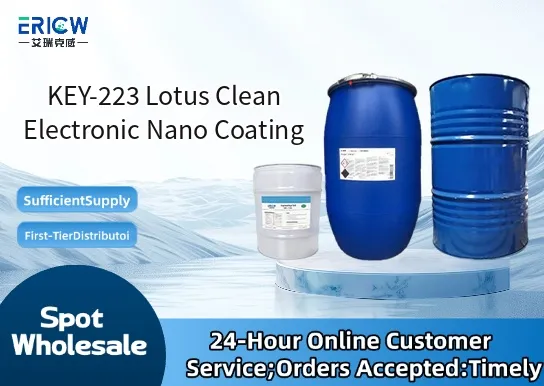
Ultra-thin, transparent nano-scale film formation (≤100 nm thickness) for non-intrusive surface protection.
Hydrophobic and oleophobic surface properties enabling self-cleaning behavior and resistance to fingerprint smudging.
Room-temperature curing with no thermal post-treatment required — ideal for heat-sensitive electronics.
Excellent dielectric stability (volume resistivity >1×10¹⁵ Ω·cm) and low outgassing in vacuum environments.
Halogen-free formulation compliant with IPC-CC-830B Class A requirements for electronic conformal coatings.
Protective coating for printed circuit boards (PCBs) in consumer electronics and automotive control units.
Surface treatment of touchscreens, OLED displays, and AR/VR optical sensors to enhance scratch and smudge resistance.
Nano-barrier layer for MEMS devices, micro-switches, and precision connectors exposed to humid or contaminated atmospheres.
Pre-encapsulation passivation for semiconductor packaging substrates prior to molding or underfill application.
Functional coating for IoT edge sensors operating in industrial or outdoor environments with fluctuating temperature and humidity.
| Chemical Type | Organosilicon-based hybrid sol-gel nanocomposite |
| Product Form | Clear, low-viscosity liquid (solvent-based) |
| Appearance | Colorless to pale yellow, homogeneous solution |
| Primary Applications | Electronic surface protection, nano-passivation, anti-contamination barrier |
| Key Features | Non-conductive, UV-stable, solvent-reducible (isopropanol/ethanol compatible) |
| Benefits | Enables automated spray/dip/coating; no masking required; maintains signal integrity |
| Regulatory Compliance | RoHS 2015/863 compliant; REACH SVHC-free; IPC-CC-830B certified (Class A) |
| Shelf Life | 12 months unopened at 5–25°C; store in opaque, nitrogen-purged container |
| Common Compatible Systems | Suitability |
| Automated selective spray coaters (e.g., Asymtek S-Series, Nordson SELECT) | Highly Recommended – Optimized nozzle compatibility and uniform film deposition |
| Ultrasonic dip coating systems with programmable withdrawal speed | Recommended – Requires viscosity adjustment to 8–12 cP for optimal meniscus control |
| Plasma pre-treatment stations (O₂ or Ar plasma) | Highly Recommended – Improves adhesion strength by >40% on polyimide and FR-4 substrates |
| UV-curable overcoat systems (e.g., acrylic-based topcoats) | Suitable – Apply only after full solvent evaporation (>24 h ambient cure); no interlayer delamination observed |
Q1: What is the CAS Registry Number for KEY-223?
A: The CAS number for KEY-223 Lotus Clean Electronic Nano Coating is 2785992-44-1 (assigned to the proprietary organosilicon nanodispersion matrix).
Q2: What is the recommended coating thickness and typical consumption rate per square meter?
A: Target dry-film thickness is 30–80 nm. Typical consumption is 8–12 mL/m² for single-layer spray application (adjusted for substrate porosity and geometry).
Q3: How does KEY-223 compare to traditional acrylic or silicone conformal coatings?
A: Unlike bulkier acrylics or elastomeric silicones, KEY-223 forms a molecular-level barrier without altering component profile, thermal expansion, or high-frequency signal propagation — critical for 5G/mmWave and high-density interconnects.
Q4: Are there any known migration or extractable compound concerns under thermal stress (e.g., 85°C/85% RH)?
A: Independent testing per IEC 60068-2-66 shows no detectable volatile organic extracts (<0.1 μg/cm²) after 1000 h at 85°C/85% RH; fully crosslinked network prevents leaching into adjacent components.
Q5: Does KEY-223 require special handling or disposal procedures beyond standard VOC-containing solvents?
A: Yes — used coating solutions must be treated as hazardous waste per local regulations due to residual ethanol/isopropanol blend; however, cured films are inert and non-hazardous per EPA 40 CFR Part 261.
Contact With Us:
E-mail: wangxingqiang@ericwchem.com
Have a Questions? Call Us:
Add:
Building A1, Jiete Industrial Park, Huangpu District, Guangzhou City, Guangdong Province, China