English
 Español
 tiếng việt
 русский
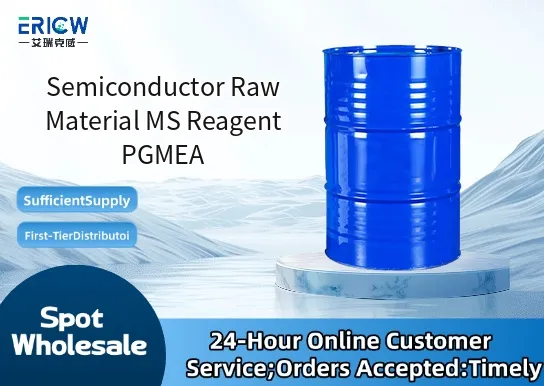
Ultra-high purity (≥99.99% GC), rigorously tested for trace metal contaminants (Na, K, Fe, Cu < 10 ppt) to prevent device yield loss.
Low volatility and controlled evaporation rate ensure uniform photoresist film formation during spin-coating processes.
Excellent solvency for common positive-tone photoresists (e.g., novolac-based and chemically amplified resists) without inducing gelation or haze.
Stabilized formulation with proprietary inhibitor system minimizes peroxide formation during long-term storage.
Consistent lot-to-lot performance validated via in-line process monitoring across advanced lithography nodes (28 nm to 5 nm).
Primary solvent in photolithography processes for semiconductor front-end-of-line (FEOL) and back-end-of-line (BEOL) patterning.
Carrier medium for photoresist dispersions used in immersion and extreme ultraviolet (EUV) lithography tools.
Cleaning agent for post-develop residue removal in wafer-level packaging and MEMS fabrication lines.
Formulation component in advanced anti-reflective coatings (ARCs) and bottom anti-reflective coatings (BARCs).
Process chemical in high-resolution mask writing and reticle cleaning applications requiring low particulate generation.
| Chemical Name | Propylene Glycol Monomethyl Ether Acetate |
| CAS Number | 108-65-6 |
| Chemical Type | Organic ester solvent |
| Product Form | Clear, colorless liquid |
| Appearance | Transparent, free of suspended particles or haze |
| Boiling Point (at 760 mmHg) | 146–148 °C |
| Density (20 °C) | 0.932–0.936 g/cm³ |
| Water Content (Karl Fischer) | ≤50 ppm |
| Common Compatible Systems | Suitability |
| Tokyo Electron (TEL) CLEAN TRACK™ and ACTUS™ Coaters/Developers | Highly Recommended – Validated for full-process integration with resist dispense, bake, and develop modules. |
| Canon FPA-1200NZ2C and ASML NXT:2000i EUV Lithography Tools | Recommended – Certified for use as resist carrier in pre- and post-exposure rinse steps under inert atmosphere. |
| Screen Semiconductor Coater/Developer Platforms (e.g., SDM series) | Highly Recommended – Optimized viscosity and vapor pressure ensure stable meniscus control during dispense. |
| DISCO DFP8760 and OKI Wafer Saw Systems (for dicing tape cleaning) | Suitable – Effective in removing residual adhesives without damaging low-k dielectrics or copper interconnects. |
Q1: What is the CAS number for Semiconductor Raw Material MS Reagent PGMEA?
A: The CAS Registry Number is 108-65-6, corresponding to Propylene Glycol Monomethyl Ether Acetate (PGMEA) in its ultra-high-purity semiconductor grade form.
Q2: What is the typical recommended usage concentration when diluting PGMEA for photoresist formulation?
A: PGMEA is used undiluted as the primary solvent in most standard photoresist formulations; dilution is not recommended unless specified in the resist manufacturer’s technical data sheet, as it may compromise film uniformity and resolution.
Q3: How does MS Reagent PGMEA differ from commercial-grade PGMEA in terms of semiconductor suitability?
A: MS Reagent PGMEA undergoes additional sub-micron filtration (<0.02 µm), rigorous trace metal analysis (ICP-MS), and organic impurity profiling (GC-MS) — ensuring compliance with SEMI C36 and S23 standards, unlike general industrial-grade PGMEA which lacks such controls.
Q4: Is MS Reagent PGMEA compliant with REACH, RoHS, and US EPA TSCA regulations?
A: Yes — fully compliant with REACH SVHC-free status, RoHS Directive 2011/65/EU (exempted substance under Annex III), and listed on the US EPA TSCA Inventory; full regulatory documentation available upon request with batch-specific CoA.
Q5: Does PGMEA exhibit leaching or migration into underlying low-k dielectric layers during post-apply bake (PAB)?
A: No significant migration occurs under standard PAB conditions (90–130 °C, 60–90 sec); thermal gravimetric analysis (TGA) and FTIR cross-sectioning confirm complete solvent evaporation prior to soft-bake completion, minimizing interfacial contamination risks.
Contact With Us:
E-mail: wangxingqiang@ericwchem.com
Have a Questions? Call Us:
Add:
Building A1, Jiete Industrial Park, Huangpu District, Guangzhou City, Guangdong Province, China