English
 Español
 tiếng việt
 русский
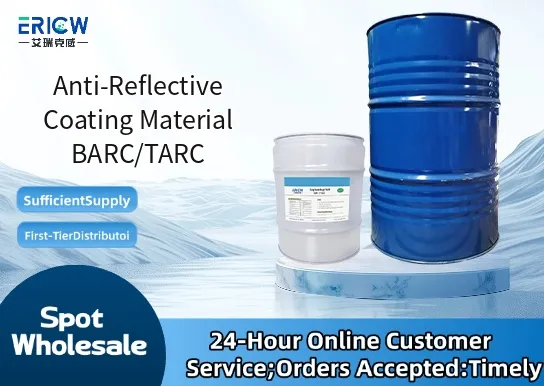
Optimized optical density and tunable absorbance for deep UV (193 nm) and EUV lithography processes.
Excellent planarization capability to minimize topographical variations in multi-layer photoresist stacks.
Thermally stable formulation with controlled outgassing behavior during post-apply bake (PAB) and post-exposure bake (PEB).
High selectivity against common photoresists and etch chemistries, enabling clean pattern transfer.
Solvent-based liquid formulation compatible with standard spin-coating equipment and process lines.
Bottom Anti-Reflective Coating (BARC) in advanced CMOS logic and memory device fabrication (28 nm to 5 nm nodes).
Top Anti-Reflective Coating (TARC) for high-NA immersion lithography and EUV patterning applications.
Interlayer dielectric planarization in back-end-of-line (BEOL) interconnect processing.
Maskless lithography support layers for MEMS and compound semiconductor manufacturing.
Hybrid lithography integration where reflectivity control is critical for overlay accuracy and CD uniformity.
| Chemical Type | Acrylate-based polymer with aromatic chromophores and crosslinking agents |
| Product Form | Clear, low-viscosity liquid solution (ready-to-use) |
| Appearance | Transparent amber liquid, free of visible particles or gels |
| Primary Applications | 193 nm immersion lithography, EUV lithography, multi-patterning schemes |
| Key Features | Tunable optical constants (n/k), spin-coatable, PEB-stable, low metal ion content |
| Benefits | Reduces standing wave effects, improves linewidth control, enhances process window (DOF & exposure latitude) |
| Regulatory Compliance | REACH SVHC-free; RoHS 2015/863 compliant; no intentionally added PFAS |
| Storage Conditions | Store at 10–25°C in sealed container; protect from light and moisture |
| Common Compatible Systems | Suitability |
| ASML NXT:2000+ immersion scanners (with 193i resist stacks) | Highly Recommended – Validated for <1.35 NA systems with standard resist/BARC bilayer protocols |
| Canon FPA-1200NZ2C EUV scanner platforms | Recommended – Requires TARC-specific process optimization and underlayer compatibility testing |
| TEL CLEAN TRACK LITHIUS Pro i+ coater/developer tracks | Highly Recommended – Fully integrated recipe support and defect control performance verified |
| Applied Materials Centura® etch systems (e.g., AMAT Kiyo™) | Suitable – Demonstrated high etch selectivity vs. ArF resists and low residue generation |
Q1: What is the CAS Registry Number for this BARC/TARC material?
A: This is a proprietary multi-component formulation; individual CAS numbers are not assigned to the final product. Key monomer constituents include CAS 768-62-7 (4-hydroxybenzaldehyde derivatives) and CAS 1330-20-7 (xylene isomers); full compositional disclosure requires signed CDA.
Q2: What is the typical coating thickness and recommended spin speed range?
A: Target dry-film thickness is 30–90 nm, achieved at 1500–3500 rpm depending on viscosity grade and substrate size. Optimal thickness is determined by optical simulation (n/k matching) for each specific resist stack.
Q3: How does this BARC/TARC compare to silicon-containing or inorganic ARCs?
A: Unlike Si-ARCs, this organic BARC/TARC offers superior etch selectivity to oxide hard masks and eliminates silicon contamination risks in gate-stack processing. It avoids the aggressive etch requirements and interface instability associated with inorganic alternatives.
Q4: Is there any risk of extractables or leachables into photoresist layers during PEB?
A: No significant migration observed under standard PEB conditions (110–130°C, 60 sec). Crosslinking is complete after PAB (90–100°C), forming a thermally robust network that prevents interlayer diffusion.
Contact With Us:
E-mail: wangxingqiang@ericwchem.com
Have a Questions? Call Us:
Add:
Building A1, Jiete Industrial Park, Huangpu District, Guangzhou City, Guangdong Province, China