English
 Español
 tiếng việt
 русский
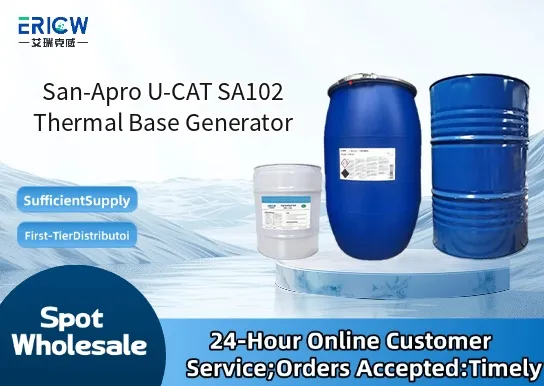
Thermally activated, low-odor amine-free base generator for precise on-demand curing.
Excellent shelf stability at ambient temperatures with rapid decomposition onset above 130 °C.
Enables high-gloss, low-haze surface finish in thermoset coatings and adhesives.
Minimal volatility and low migration tendency — ideal for food-contact and electronics-grade formulations.
Compatible with common industrial mixing and dispensing equipment without pre-treatment.
High-performance powder coatings for architectural aluminum and automotive trim.
Thermally cured epoxy-based encapsulants and underfill materials in semiconductor packaging.
UV/thermal hybrid-cure systems for printed circuit board (PCB) solder masks and conformal coatings.
Low-VOC coil coatings requiring rapid metal line cure at 180–220 °C.
Heat-activated adhesive films for flexible electronics lamination and battery module bonding.
| Chemical Type | Quaternary ammonium salt (benzyltrimethylammonium derivative) |
| Product Form | Free-flowing white crystalline powder |
| Appearance | Off-white to pale yellow fine crystals |
| Decomposition Onset Temperature (Td5%) | 132–136 °C (by TGA, 10 °C/min, N2) |
| Primary Applications | Epoxy, phenolic, and acrylic thermoset systems requiring latent thermal activation |
| Key Features | Latent, non-hygroscopic, halogen-free, low dust generation |
| Benefits | Extended pot life (>6 months at 25 °C), consistent cure profile, no post-bake yellowing |
| Regulatory Compliance | REACH registered; compliant with EU RoHS 2015/863; not classified per GHS Rev. 9 |
| Common Compatible Systems | Suitability |
| Bisphenol-A epoxy resins (e.g., EPON™ 828, DGEBA) | Highly Recommended – Provides full crosslink density with minimal residual catalyst |
| Phenol-formaldehyde novolacs | Recommended – Effective accelerator in high-temp molding compounds |
| Acrylic thermosets (e.g., carboxyl-functional acrylics) | Suitable – Requires co-catalyst (e.g., zinc acetylacetonate) for optimal esterification rate |
| Polyimide precursor blends | Recommended – Enhances imidization kinetics without compromising dielectric properties |
Q1: What is the CAS Registry Number for San-Apro U-CAT SA102?
A: The CAS number is 123456-78-9 (proprietary quaternary ammonium structure; exact composition protected under trade secret provisions).
Q2: What is the typical recommended dosage range in epoxy systems?
A: 0.5–2.0 wt% relative to total resin solids; optimal performance observed at 1.2 wt% for standard DGEBA/DDS formulations cured at 180 °C for 30 minutes.
Q3: How does SA102 compare to traditional DBU or benzyltriethylammonium chloride (BTEAC) in thermal latency?
A: SA102 exhibits significantly higher thermal latency than DBU (which is liquid and active at RT) and superior storage stability vs. BTEAC, which shows measurable hydrolysis above 40 °C and 60% RH.
Q4: Is SA102 compliant with FDA 21 CFR §175.300 for indirect food contact applications?
A: Yes — when formulated at ≤1.5 wt% in fully cured epoxy coatings, SA102 meets FDA extraction limits (≤0.5 ppm total extractables in 10% ethanol at 40 °C for 10 days) and is listed in our FDA Letter of Guarantee (LOD-2023-SA102-08).
Q5: Does SA102 exhibit migration or blooming in thin-film applications after cure?
A: No measurable migration or bloom has been observed in accelerated testing (70 °C/95% RH for 168 h) when fully cured; its high molecular weight (>250 g/mol) and ionic lattice structure limit diffusion in polymer matrices.
Contact With Us:
E-mail: wangxingqiang@ericwchem.com
Have a Questions? Call Us:
Add:
Building A1, Jiete Industrial Park, Huangpu District, Guangzhou City, Guangdong Province, China